 |
 |
About us I Information I Brochure I Events I A.i.R. I Workshops I Gallery I Featured Artist I Accommodation I Location I News I Contact I Links | > Français | |
|
 |
| Archived events >> |
|
October 2025
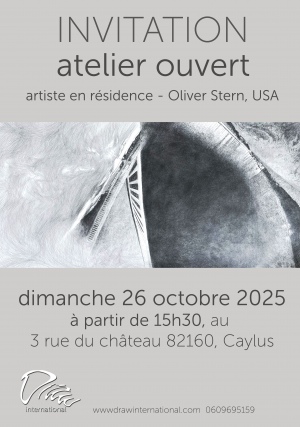
Open Studio We invite you to the last open studio of our 2025 residency program.
Come and meet young American artist Oliver Stern and discover his drawings inspired by his adventures in the local landscape.
We hope to see you this Sunday for this final event of the year.
|
 |
||
|
August 2025
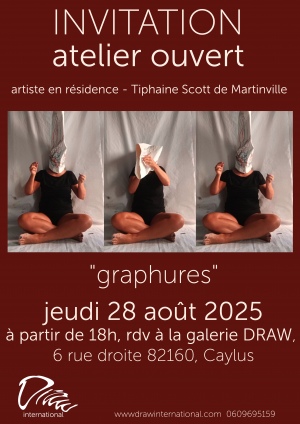
Graphures My work mainly explores the embodiment of the élan vital (life force) orientated towards a desired horizon.
When I arrived at Grete and John’s, I had in mind to continue the graphic reflection on the words I have been collecting for two years from participants in maieutic sessions, without names or dates. I reconstitute these into scrolls, which I consider “mental filmstrips” of an impulse in the process of advenir (coming-into-being). From these scrolls, I have also extracted an alphabet of logograms—somewhere between transitional objects and elements for new graphic phrases. More broadly, I tirelessly attempt to organize a thinking of the advenir through a metaphorical cartography of a brain populated with monsters and instruments of language, designed to help propel the élan vital toward the desired horizon.
Although these objects accompanied me during this residency, what I mostly shifted into here is what I now call haptic drawing: attempting to grasp through line—generally with eyes closed—the internal oscillations of impulses moving through the head or body, my own or that of others, as well as plants collected along my walks. The protocols take into account the touch of one hand, while the other hand seeks, through line, to render the variations. This performative exercise gives rise to line drawings in various formats, leaving behind matrices of what has come into being.
After a first career as a lawyer, I have been pursuing a path as an artist for the past 15 years, which notably led me to resume art studies five years ago. I graduated in 2024 from the École des Beaux-Arts of Le Mans with honors, and I am also completing a master’s degree at Paris VIII, focusing on the ecology of arts and media. I wish to continue my artistic research on the élan vital, particularly through dedicated residencies that provide the distance and maturity necessary for reflection.
My warm thanks to Grete and John who, through their constant support and questioning, have carried my work into new dimensions.
Tiphaine Scott de Martinville, August 2025
|
 |
||
|
July / August 2025
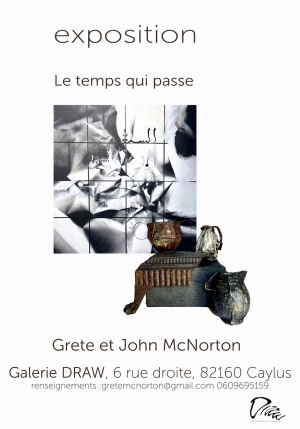
Le temps qui passe
|
 |
||
|
July 2025
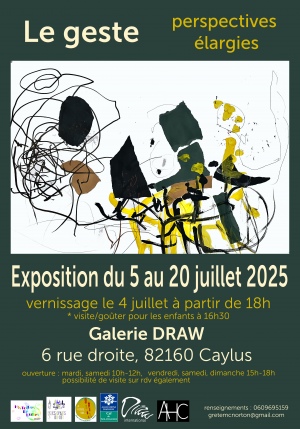
Le Geste Young children’s drawings : what do they convey?
There are many stages that young children go through in their early explorations of the world around. This is evident in early drawings and continues until adolescence. Drawing exists as a graphic equivalent of what humans, past and present, continue to see, hear, smell, touch and kinaesthetically feel about who and where they are in time and space. Art history provides clear evidence of the developing and varying spatial understandings throughout the centuries.
Children also need that space and time in order to meaningfully explore ideas. Borrowing the words of the philosopher Ludwig Wittgenstein: ‘What has history got to do with me, mine is the first and only world’. That is also true for the young child. At an early stage of development there are so many matters to deal with. So much to familiarise oneself with. As we all know as parents, a great deal is learnt during these early years and a varied informed educational experience is vital. We all learn differently and the relevance of activities that foster interests provides that readiness to receive and therefore confidently experiment.
The drawings exhibited reflect the work produced during several months workshops and describe precisely what two to three years olds experience, without predeterminism. The results are accomplished, thoughtless and thoughtful as a communication of the physical pleasure for materials and the gestural marks, lines and shapes they provide. It has been an absolute pleasure to witness the energy, concentration and outcomes of their creative endeavours. It was moving and impressive to witness how caring and sensitive they were with the work and with each other, so apparent when again seeing the fruits of their talent and ideas.
Thank you for the opportunity.
John McNorton M.Ed, PhD RCA (London) Director DRAWinternational
|
 |
||
|
April 2025
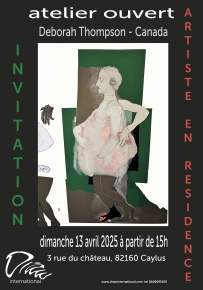
Open studio - Deborah Thompson (Canada) Five years ago I shifted my visual art practice from painting to working with drawing, specifically with drawn imagery and cutouts as a way to build figurative-based compositions and with stop motion animation works using my drawings. Although, drawing was integral to my painting process, it is now with this new direction, the centre of my practice. It is an exhilarating time in my practice.
Here in Caylus, at DRAWinternational over the past 6 weeks, I have continued in this new direction to extend my understanding of my visual language with these materials through explorations with translucent papers, ‘stand -alone’ figures, and the addition of colour and texture through the use of coloured pencils.
I feel that I bring many aspects of my daily existence and my ongoing curiosities into the studio and the work manifests or becomes from these influences and experience. For example, my daily walks in nature, my reading, dreams and investigations into the deep history of this area together joined me in the making of new work. I am especially interested in the gargoyle of “Maison des Loups”, the forest floor with its vines and lichens, the frog pone (although I started these frog drawings before I heard the magnificent spring chorus, the history of the witch and werewolf (all shapeshifter types) legends.
A wall piece usually begins with a drawing of a face. I am fascinated by faces and in drawing them I seek to touch ‘soul’. I draw many faces only a small number of them become a larger piece. Once I feel a numinous connection to a drawing of a face, a conversation begins where I ‘listen’ to what the face is suggesting to me - who it will become and what it is in relationship to this includes colour, texture, body form, background environment etc….until I feel the work is complete. These pieces here have come together quickly, back home it may be months before my work takes shape. Play and intuition are key, whereas ideas usually stop the growth of a piece. I don’t make preliminary sketches rather work directly on the wall in an additive and subtractive fashion.
My art is a way for me to respond to images and to employ my imagination. My primary interest over the past two decades has been in the human and animal body as a way in which to explore the unconscious and express my emotions. Now, at this stage in my life, I am interested bringing my awareness to the kinships and relationships that the human body shares with plants, animals, reptiles / macro and micro….matter of all sorts. I am interested in dissolving binaries that trap us into thinking less of one thing and more of another, such as the idea that consciousness exists in the mind not the body. Through my work I seek to celebrate our interdependencies that allow matter to continually shapeshifter and renew itself. To imagine new ways ‘to become’ in an ever changing world.
I have for a long time had a fascination with the medieval period, so I am thrilled for the time and space to live and work in such a historically rich village! The impact of this experience will be felt for years to come. I am grateful to have made friends with so many genuine humans, and who welcomed me into the folds of this wonderful French culture. I am particularly grateful to have participated in a residency at DRAWinternational and for the fine care of, and conversations with directors Grete and John McNorton and their daughter Aloïse.
Deborah Thompson
|
 |
||
|
28 July 2024
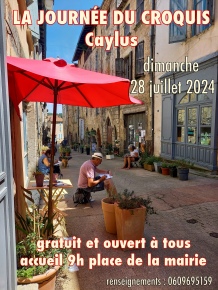
Get your pencils out! Urban Sketchers - Caylus "Urban Sketchers" live drawing, all day long.
An exhibition of participants' notebooks under the market hall, at the town hall square at 5:30pm.
|
 |
||
|
28 July 2024
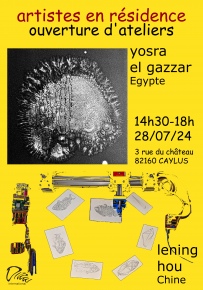
Open studios Artists Yosra El Gazzar (Egypt) and Lening Hou (China) currently in residence open their studios to the public.
|
 |
||
|
28 July 2024
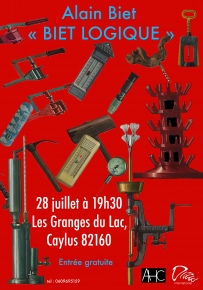
"BIET LOGIQUE"
Screening "BIET LOGIQUE" at 7:30 p.m.
Incompliment to his exhibition "Halleboteur" at the Galerie DRAW Caylus
|
 |
||
|
July - August 2024
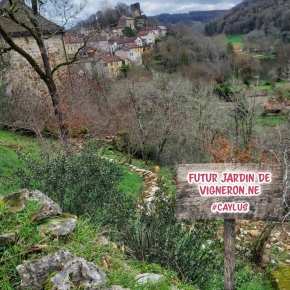
AIR Le jardin de Vigneron.ne Artist residency ‘le jardin de vigneron.ne’ July/August 2024
‘le jardin de vigneron.ne’ Caylus, is a long-term project that aims to contribute to the cultural dynamic of the village, encourage social integration and to acknowledge its rich winegrowing past. We also want to use contemporary art to raise awareness and highlight the process of working the land, so each stage of its transformation is visible and can be experienced by all.. These creative actions will encourage receptivity, curiosity, and help us to embrace new perspectives, ideas and values.
We are seeking artists to take the first steps with us to launch the project. It is an opportunity to explore the world of the vine and the winemaker and to create works that reflect, inspire and innovate.
Artist residency ‘le jardin de vigneron.ne’ from July 22 to August 31, 2024
The Jardin de Vigneron.ne aims to reconnect a remarkable natural site with its wine-growing past. Aware that biodiversity is the sustainable winegrower's best ally, we wish to highlight the creative cycle of this land and share its natural assets with a new generation. Through artistic and cultural actions around the vine, very sensitive to its environment, the wine garden will be a constant source of exchanges and new perspectives for artists, artisans, rural farmers, residents and visitors: a place to nourish connections, gather our collective energy and raise a glass to the living world throughout the seasons!
The garden of vigneron.ne - a place where artists explore the intersection of art and ecology. A wine garden, looked at with other eyes, explored by omnipresent and sensory means. A project that will enable new perspectives, generate stories and offer possibilities for a more sustainable relationship between humans and their habitat. A wine garden that will contribute to the cultural wealth and biodiversity of the region.
We are looking for artists from all disciplines who have a particular interest in drawing and the environment and who, through their own practice, will explore, develop and create work inspired by and working with the natural and cultural environment.
Artists will be hosted at a vineyard for one week and the remaining four weeks will take place at DRAWinternational residency..
“The winegrower expresses his land but also his personality. Just like the artist » Michael Latz, winemaker.
“The winemaker integrates into his wine not only his love of the land and his respect for nature, but also his human qualities, his identity, his values: and as such, his work reveals an element of artistic sensitivity. Which makes him a wine artisan. The artist, for his part, embodies the expression. He often expresses in unusual forms what others do not see or feel.” *
The challenge of this initiative is therefore to bring these two art forms into dialogue with each other and with the public.
*Simona Pizzuti on the 2023 Art and Wine edition
|
 |
||
|
September / October 2024
Open Call - Artist in Exile OPEN CALL 2024 – Artist in exile AiR DRAWinternational Drawing research centre Caylus, Tarn and Garonne, Occitanie, France
Les Abattoirs, Musée – Frac Occitanie Toulouse and DRAWinternational, already partners in the curation of exhibitions of works from the collections of the Abattoirs since 2018, and hosting artists from Ukraine in 2022 and 2023, are joining forces in 2024 to host an artist in residence in Caylus who is in exile in France.
DRAW - drawing, research, action and works The centre is a place for research, experimentation and production of drawing in all its forms, which examines concepts, methods and significance of material within the discipline of contemporary drawing and encourages the sharing and exchange between the artist and the public.
DRAW hosts international artists who, for several weeks, take possession of the studios to reflect, experiment and create works. DRAW's support is both practical and theoretical at the heart of contemporary thinking.
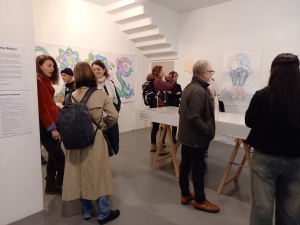
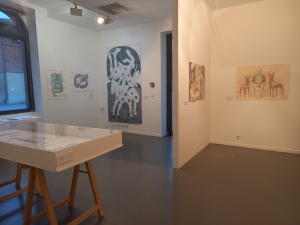
Workshop - Accommodation The artist has a studio and independent accommodation in a medieval building in the centre of the village. Additional facilities include large format space, technical workshop, etching press, top loading oven and technical support. Internet access via Wifi for personal laptops. A gallery space for works in progress or completed works is also available where appropriate. The artist is offered academic support and access to relevant documentation. Regular discussion of work to include individual and group critiques and practical workshops if requested. Documentation of studio practice. Support for artists to encourage integration within the community. Editing and translation of written text. An evening meal is provided by the centre for all artists once a week and artists are taken on cultural visits in relation to their particular projects. DRAW organizes events such as, exhibitions, open workshops and seminars/presentations Open Studios event , to promote it's activities, share creative experience and opportunities within the public domain. Duration of residency 8 weeks – September - October 2024 Fees and support Les Abattoirs, Musée – Frac Occitanie covers the cost of the residency for 8 weeks (studio and accommodation), travel to Caylus and a €2,000 creation grant - this does not include meals. Residency Restitution Les Abattoirs, Musée – Frac Occitanie Toulouse will organize an exhibition of the work produced during the residency at les Abattoirs, in Toulouse, in December 2024.
Application requirements:
1. A portfolio of recent work which includes a short biography. 2. A statement of intent for the residency - project proposal. Please send your application in French or English to emmanuelle.hamon@lesabattoirs.org before 10 July, 2024.
|
    |
||
|
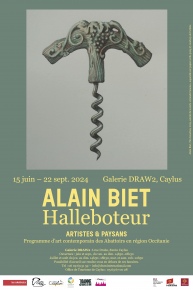
15th June to 22nd September 2024
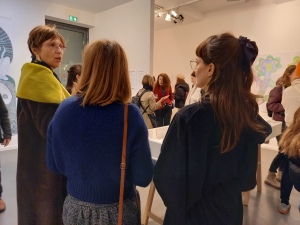
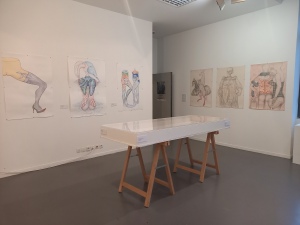
Exhibition ALAIN BIET 'Halleboteur' We invite you !
DRAW2 Gallery, 6 rue Droite, Caylus.
Les Abattoirs, Musée – Frac Occitanie Toulouse and DRAWinternational, already partners in organizing exhibitions of works from the Abattoirs collections, are joining forces in 2024 to welcome the artist Alain Biet.
As part of the programme 'Artists and Farmers', Alain Biet returns to his origins as the son of winegrowers. He once carried ou all the vineyard tasks within the family farm, before undertaking an artistic career. With the title of the exhibition, the artist asserts an identity, a story. Indeed, “halleboteur” is a Touraine term which designates a person who gathers the grapes forgotten in the vineyards after the harvest. This term also has a literary history: it is referenced in the famous novel by François Rabelais Gargantua (1534), whose story, which is located in Touraine, praises wine: "a precious liquid endowed with great virtues". Alain Biet thus comes, in a way, to "hallow" his perhaps forgotten memories and offer a new flowering of them through a profusion of drawings of familiar objects linked to the wine-growing world.
|
 |
||
|
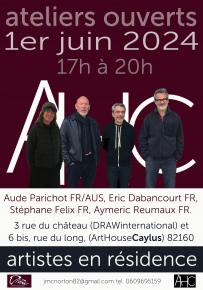
01/06/2024
Open studios and musical evening. End of residency exhibition and music event!
You are invited to the presentation of research and works created by the four artists.
A time for friendly exchange with Aude Parichot FR/AUS supported by National Art School, Sydney and then with Eric Dabancourt, Stéphane Felix and Aymeric Reumaux, our first artists in the new micro-residency programme with ArtHouseCaylus and La Fabrique Caylus.
The event takes place in two spaces, first at DRAWinternational 3 rue du château, then continues at the ArtHouseCaylus space, 6 bis rue du long, and ends with music by Retro Kandy.
We will meet at 5 p.m. at 3 rue du château to visit the studios together.
See you Saturday June 1st!
|
 |
||
|
3 May 2024
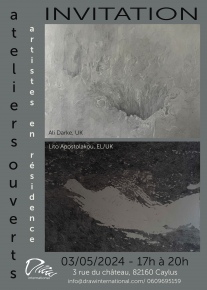
OPEN STUDIOS Ali Darke and Lito Apostolakou are opening their studios to the public this Friday, May 3, 2024.
Come see the development of ideas and processes around “sleep” that the artists are exploring through drawing, sculpture and video.
Open Studios - 5pm to 8pm 3 rue du château, 82160 Caylus
|
 |
||
|
28 april 2024
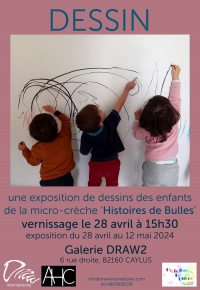
Exposition - DESSIN Cette exposition présente une sélection de dessins réalisés par les enfants lors de plusieurs ateliers organisés par Grete et John McNorton (DRAWinternational) à l'espace de projet 'ArtHouseCaylus'.
Ce n'est que le début d'une collaboration entre DRAWinternational, ArtHouseCaylus et Histoires de Bulles.
Une initiative conçue pour initier les enfants au monde de l'art en leur proposant différentes expériences artistiques et souligner l'importance de ces activités créatives pour le développement de l'enfant.
|
 |
||
|
13 April 2024
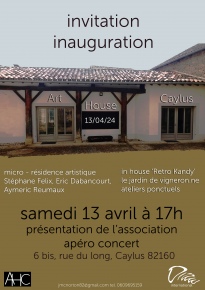
Inauguration ArtHouseCaylus - micro résidence. Spring, season of rebirth!
Join us to celebrate the renewal of the ArtHouseCaylus association.
A new space with new projects to promote local artists and cultural and social exchanges.
Come and share a friendly moment around an aperitif - plancha - musical!
The ArtHouseCaylus and DRAWinternational team with our 'in house' band Retro Kandy.
|
 |
||
|
24 March 2024
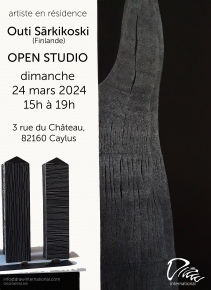
Open Studio - Outi Särkikoski I am trained as a graphic designer but I ended up making ceramics for decades. Drawing has still always been close to my heart and I came here to focus on it.
Two months at DRAWinternational residence have been very rewarding for me. I have experimented with different ways of making ”marks on paper” and the works I made here are like sketches that I will continue later in my home studio.
Three monoprints called Cliffs of Åland I made earlier during my residence in the Åland archipelago. Those beautiful islands between Finland and Sweden are very dear to me and I often visit them.
The work Japanese moon is made on calligraphy paper. I like Japanese culture and I share its passion for the moon too.
One of the most memorable experiences here was visiting the Pech Merle Caves to see the origins of the art of drawing. It was something unique and will always stay in my mind.
I now know a little more about the French way of life, a little more about the language, a little more about drawing. Thank you!
|
 |
||
|
14 December 2023
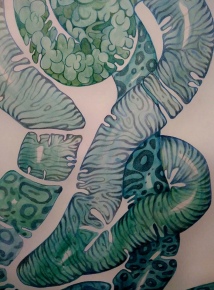
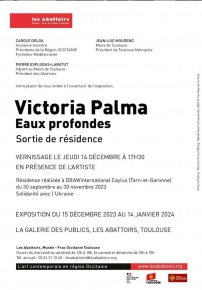
Eaux Profondes - Sortie de résidence - Victoria Palma Deep Waters
A world not as it is but how it might be. An embodiment of the self in the depths of the oceans can only conjure up realities that we are not aware of. Whether they are scientifically observed or creatively imagined, they offer something splendid in all their glory. These creatures not only speaking to us, but listening to us too, a perceptual reciprocity.
Language and communication between Victoria and ourselves reminded us of the complexities of dialogue. This brought to mind something mentioned by Wittgenstein, 1975, in his book entitled: Philosophical Remarks: ‘We do not start from certain words, but from certain occasions or activities.’
Language comes about through a relationship of the physical self with that of others. These first acts of language do not have a conventional syntax, but is more child-like, pre-verbal, intuitive, pre-logical, concrete and always in the present.
This wonderful joyous relationship we have had with Victoria has been dynamic, fascinating certainly challenging, but always fun and absolutely in tune with her talent for conjuring up vital and surprising imaginative creatures that defy the ‘language’ of our everyday life experiences.
We have a saying in English which states: ‘calm waters run deep’, but Victoria’s ebb and flow of those stormy oceanic seas below, evoke in us, wonder and delight and clearly establish her creative and energetic skill as a professional artist.
Thank you Victoria
John McNorton M.Ed. PhD, RCA (London) Director DRAWinternational.
|
  |
||
|
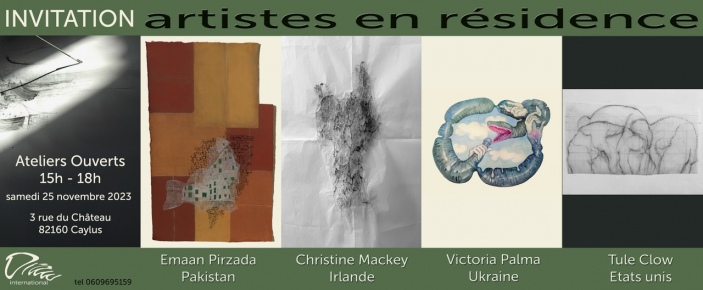
25 Novembrer 2023
Open Studios Our final 'Open Studio' event of 2023 this Saturday, November 25 is really festive!
See you Saturday !!
The artists' studios will be open to the public from 3 p.m. to 6 p.m., you will be able to visit each studio and meet and chat with the artists.
|
 |
||
|
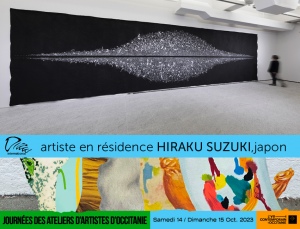
14 / 15 Octobre 2023
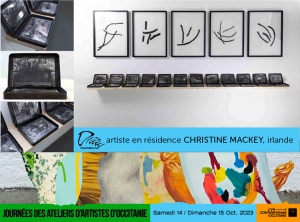
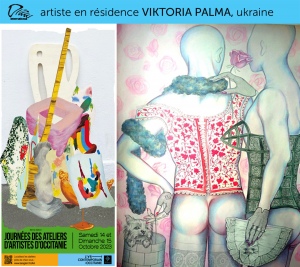
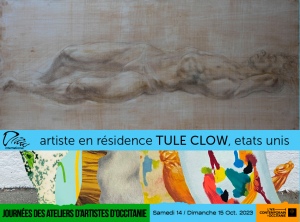
Studio Open Days - Artists in Occitanie This Saturday and Sunday DRAWinternational is participating in the 6th Occitanie Artists’ Open Studio Days.
We will have the pleasure of introducing our four artists in residence HIRAKU SUZUKI, Japan, CHRISTINE MACKEY, Ireland, VIKTORIA PALMA, Ukraine and TULE CLOW, United States.
Come and push open the doors of their studios and share a moment of exchange, discussion and ideas around the creation of contemporary drawing.
Meet Saturday 14 and Sunday October 15 from 3 p.m. to 6:30 p.m. at DRAWinternational, 3 rue du château and 6 rue Droite 82160 Caylus.
|
    |
||
|
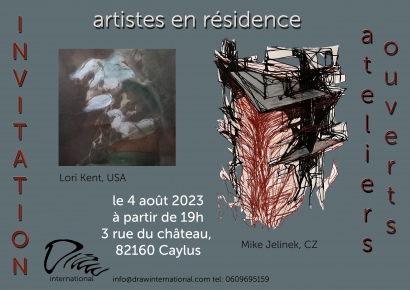
August 4, 2023
Open Studios Enter the world of artists' Lori kent and Mike Jelinek by visiting their studios, 3 rue du château. An important opportunity for the artists to share an insight in to their practice with the public.
|
 |
||
|
August 4, 2023
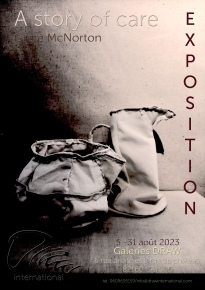
Exhibition - A story of care
" A body of work inspired by the stories and souvenirs that objects and fabrics hold, embracing the imperfect reality of a repaired, transformed and renewed life'
Grete McNorton Open from Thursday to Sunday from 3 p.m. to 6.30 p.m. and Tuesday and Saturday mornings from 10 a.m. to 12:30 p.m. All day on the 14/15 of August. Also by appointment tel 0609695159
|
 |
||
|
July 2, 2023
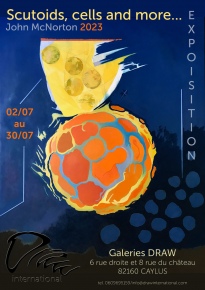
Exhibition - Scutoids cells and more... Scutoids, cells and more…
‘Life's challenges demand a contemplative attitude and aesthetic expression is a powerful way forward for both artist and viewer’.
The works exhibited in the two galleries are a selection of various paintings made in Caylus over the past 15 years.
I sincerely hope that these works offer a positive point of view to help generate a feeling of well-being.
John McNorton
|
 |
||
|
4 june 2023
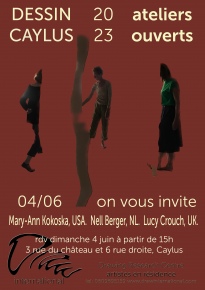
Open Studios June 4 - Come and meet the artists currently in residence.
At 3pm on Sunday afternoon take a tour of the artists' studios - Mary-Ann Kokoska, Nell Berger and Lucy Crouch.
6 rue droite and 3 rue du Château, 82160 Caylus.
Experience a privileged encounter during which you can meet the artists in residence, discover their creative spaces and their work in progress.
The Open Studios aim to offer the public the opportunity to discover the drawing practice of each artist in residence at DRAWinternational, in order to make their artistic processes transparent and accessible.
The Open Studios favour exchanges with artists and give an overview of their practice. Texts in French and English are used to contextualize the works presented.
See you on Sunday !
|
 |
||
|
10 april 2023
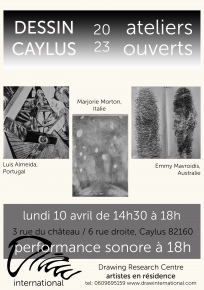
Open Studios Our first open studio event of 2023 - invitation
|
 |
||
|
January 2023
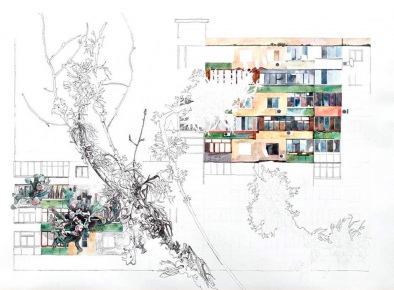
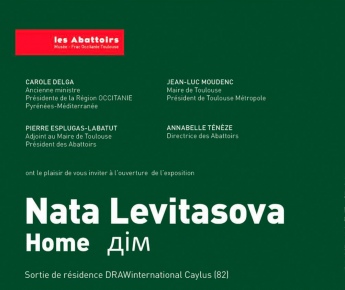
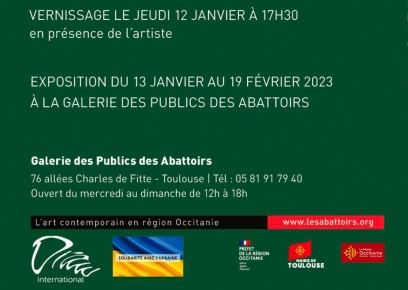
Residency restitution HOME: End of residency exhibition with artist Nata Levitasova.
This time of exchange with the public is really precious for the artist, allowing them to reflect on their work and to imagine possible new avenues in relation to feedback from the public.
We hope to see many of you there!
Opening on Thursday January 12 at 5:30 p.m, in the presence of the artist, at the Galerie des publics des Abattoirs.
|
   |
||
|
November 2022
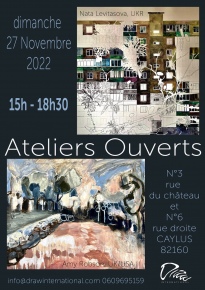
Open Studios We are very happy to welcome Nata, a talented and driven artist from the Ukraine, to our centre DRAWinternational in the heart of the small village of Caylus. The environment is such a positive contrast for her and the experience allows her to reflect and expand her professional practice.
Welcome to the ‘Ateliers Ouverts’ this Sunday November 27 from 3 p.m. to 6:30 p.m. at 3 rue du Chateau and 6 rue droite, 81260 CAYLUS
|
 |
||
|
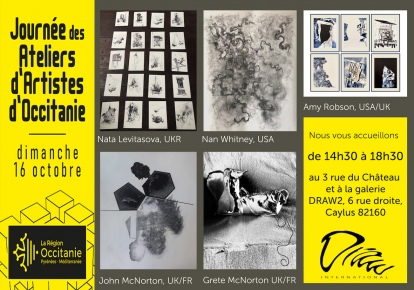
16/10/2022
Open Studio Day for Artists of the Occitanie region. It's the Open Studio Day for Artists of the Occitanie region.
Come and discover the work of our artists in residence:
Nata Levitasova - Ukraine, Nan Whitney - USA and Amy Robson - USA/UK.
Both of us will also have our works to show you!
Starting at 2:30 p.m. at the DRAW2 gallery, 6 rue droite and 3 rue du château for the artists' workshops.
Hoping to share another moment rich in exchanges and discoveries.
|
 |
||
|
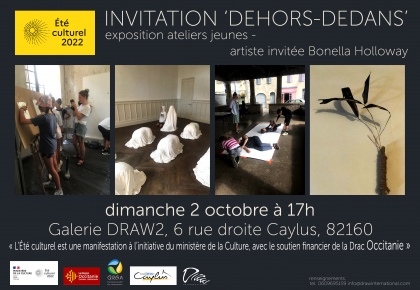
October 2022
Eté Culturel - Exposition Ateliers Jeunes. “DEHORS-DINS” a cultural project for local young people. The exhibition AWAKEN 'First Order and Beyond' challenges the understanding of certain works of art with a deeper and more contemplative consideration. Similarly, the workshops for young people were intended to encourage a more thoughtful approach to what can be hidden behind a series of works. Specific, unfamiliar drawing methods were used to introduce the other senses, such as touch and kineasthesia which inform and relate, consciously or unconsciously, to the dominant sense of sight. Several works made by the young people, resolved and unresolved, will be exhibited along with a creative video and photographic still images to reveal the processes and discussions during the workshops. This presentation should be seen as an educational panorama, faithful to the group, to show what each of them can understand and can communicate.
|
 |
||
|
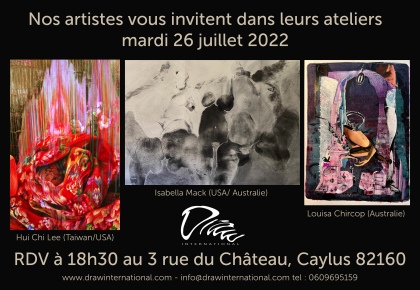
26th July 2022
INVITATION - Open Studios Artistes Hui Chi Lee, Isabella Mack and Louisa Chircop open their studios to the public this tuesday evening from 6.30pm. Come and discover their drawing practice, their ideas, the processes and techniques used for creating their works. An invitation to visit the studios and exchange with the artists.
|
 |
||
|
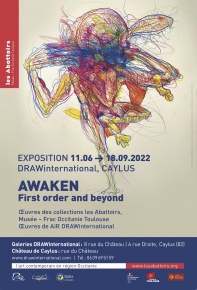
June 11th to September 18th 2022
AWAKEN First Order and Beyond Art practice, thoughts and feeling about art, in all its form, is a necessary cultural component for progress. Today, as in the past, artists have challenged what we perceive and how we may interpret the world. However, some artistic work does require, or even may demand, a longer and deeper reflective consideration, if we are to unravel its possible hidden or ‘coded’ meaning. With a short glance we do not always detect a level of meaning beyond a first hand observation. Further exploration of an artists’ lifestyle and their working methods, besides the opinion of others, can therefore enhance an appreciation and a deeper understanding. To gaze with a ‘sensitive eye’ at works of art can evoke a sense of inner wellbeing, giving insight into how the world could be. Just as important, within the creations of other artists, the message can seem less optimistic, conveying a future which portrays destruction and uninhabitable mayhem. We are in potential danger if we turn a blind eye. Both perspectives offer an opportunity for serious contemplation about the world as it is and how it could be. Art is able to wake us up to realities both present and future to instigate a release of ideas for action and change, from that entrenched mind-set position. Aesthetics and visual traditions have to be liberated to expand the parameters of everyday human experience. In so doing maybe then we are better equipped to think and take action for relevant change. A more critical approach to artistic creations promotes a wider perspective of thoughts and questions about artistic concepts, methods and material. A ‘radical aesthetics’ is not a phrase to be afraid of but an embracing attempt to emancipate individuals in a multi-sensory, collaborative, participatory and transitory way. It is a move toward a lifestyle that shares and reflects true and honest facts and those innate feelings that are also shared and articulated in science and the humanities at large. The artists presented in the exhibition AWAKEN - First order and beyond evoke this issue in many ways. Collections les Abattoirs, Musée – Frac Occitanie Toulouse : Gilles Barbier, Walter Barrientos, Democracia, Bernard Dufour, Safaa Erruas, Daniel Gerhardt, Mehdi-Georges Lahlou, Myriam Mechita, Clément Thomas, Gisèle Vienne, Jérôme Zonder OEuvres de AiR DRAWinternational : Armando Chant, Antonia Guerrero, Edita Kadiric, Robbie Karmel, Liesje van den Berk Opening times: June and September : Friday to Sunday 14h30 - 18h30 July and August : Thursday to Sunday 14h30 - 18h30 and Tuesday and Saturday 10h à 12h30. Galeries DRAWinternational 1 & 2, 8 rue du chateau et 6 rue droite et le Chateau de Caylus (82) info@drawinternational.com 0609695159
|
 |
||
|
17 April 2022
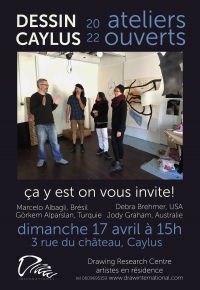
Open Studios It is with great pleasure that we open our artists' studios to the public on Sunday April 17th. Restitution of residency for artist Görkem Alparslan, Turkey and art writer Debra Brehmer and just the start of the residency for artists Jody Graham, Australia and Marcelo Albagli, Brazil who will be with us for two and three months respectively. Join us on Sunday for the opportunity to meet and discuss ideas with the artists in an informal and friendly environment and share our passion for drawing.
|
 |
||
|
28 November 2021
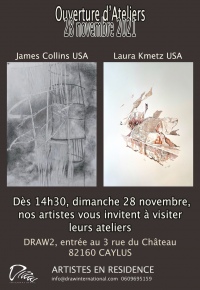
Open Studios - Invitation The last event of 2021. Artists in residence James H Collins and Laura Kmetz invite you into their studios, come and see their work chat with the artists and talk about drawing.
|
 |
||
|
14th July 2021
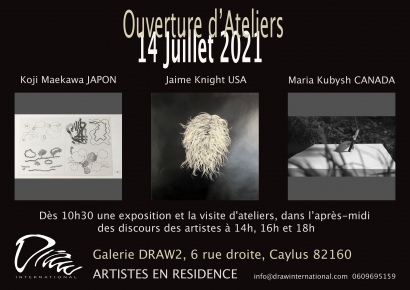
Open Studios - Invitation Koji Maekawa, Jaime Knight and Maria Kubysh have taken possession of the DRAW studios for several weeks already, on July 14 they invite you to discover their way of thinking and creating contemporary drawing.
From 10:30 am you can visit the exhibition as well as their studios in the afternoon there will be three sessions of 'Artist Talks' where each artist will present their respective projects at 2 p.m., 4 p.m. and 6 p.m.
We ask you to reserve your place for the 'Artist Talks' in order to be able to respect the current health instructions.
The exhibition will be visible until July 18 from 10 a.m. to 12 p.m. and from 2 p.m. to 6 p.m. It will also be possible to visit the artists' workshops by appointment.
It is a real pleasure for us to support artists in their research and practice as well as to promote their work by sharing our passion with you.
Sincerely,
John and Grete
|
 |
||
|
10/11 April 2021
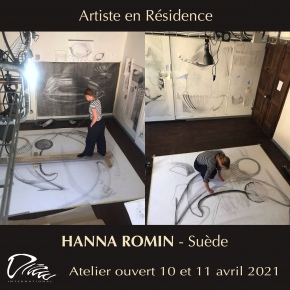
Open studio - Invitation We are happy to announce that Hanna Romin (SE) is opening her studio this weekend:
Saturday April 10 from 2:30 p.m. to 6:30 p.m. (arrivals 2:30 p.m. / 3:30 p.m. / 4:30 p.m. / 5:30 p.m.)
Sunday April 11 from 2:30 p.m. to 6:30 p.m. (arrivals 2:30 p.m. / 3:30 p.m. / 4:30 p.m. / 5:30 p.m.)
For those who are more than ten kilometers from home, I can send you a personal invitation and you can tick box 6 on the exceptional travel certificate
• Travel to an open cultural establishment
For everyone's safety, we offer two dates with specific times, as we have to limit the number of visitors at a time.
We ask you to contact us to tell us the time of your arrival by email or by tel 0609695159.
Wearing a mask is compulsory.
The last opening of our artist-in-residence studios was already complicated. We were happy to welcome everyone who was able to come, and there were many of you.
This is a very important event for artists, all the more so at the present time when for them meetings / exchanges are almost non-existent and it is one of the key elements of a residency.
Sincerely,
John and Grete
|
 |
||
|
19/21 February 2021
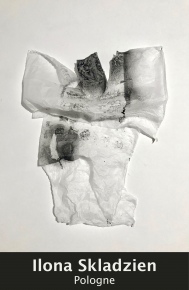
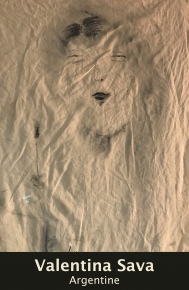
AN INVITATION, A GATHERING, A PASSION We are happy, after a year of uncertainties, to be able to invite you to our new space to meet our first artists in residence, ILONA SKLADZIEN and VALENTINA SAVA.
Our wish is to develop and reveal the various processes of contemporary drawing and to share and exchange ideas between the artist and the public.
Since we have to limit the number of visitors for everyone's safety, we propose two dates with specific times.
We ask you to reserve your place -
Friday February 19 2:30 p.m. to 3:30 p.m. 3:30 p.m. to 4:30 p.m.
Sunday February 21 2:30 p.m. to 3:30 p.m. 3:30 p.m. to 4:30 p.m.
Wearing a mask is compulsory.
|
  |
||
|
October 2020
Art Workshops Art workshops
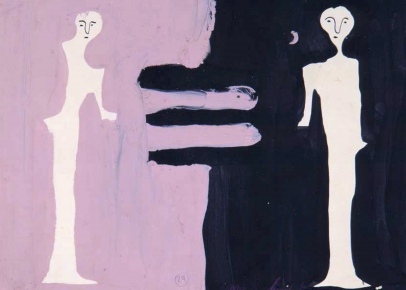
Art reminds us that we are not alone and that we share a universal human experience. Through the exhibition 'Not I', alone, Grete and John accompany you on your encounter with contemporary art, highlighting the works they have selected from the Abattoirs Musée Frac Occitannie Toulouse collections.
Art workshops linked to the exhibition: drawing, printmaking and mixed media
October 21 to 23, 2020 - 3 consecutive sessions
Children - Wednesday/Thursday/Friday 2 p.m. to 3:30 p.m. 72 euros materials provided Teens - Wednesday/Thursday/Friday - 4 p.m. to 6 p.m. 96 euros materials provided
October 26 to 28, 2020 - 3 consecutive sessions
Adults - Monday/Tuesday/Wednesday - 2 p.m. to 5 p.m. 162 euros materials provided
Whether you are beginners or experienced, these workshops offer an introduction to artistic practices and their development.
Places limited to 4 For more information, tarifs and reservations tel 06 09 69 51 59 /info@drawinternational.com
|
 |
||
|
October 2020
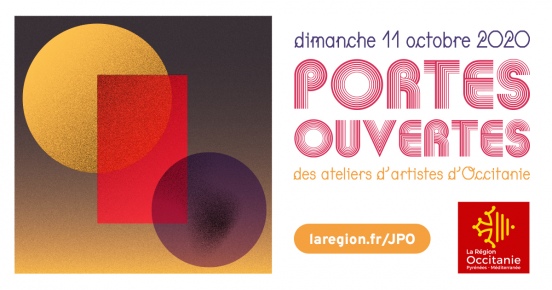
Open studios REGIONAL OPEN DAY - ARTISTS STUDIOS - OCCITANIE Our studios are open: 10h30 à 12h 30
14h30 à 18h
|
 |
||
|
September/October 2020
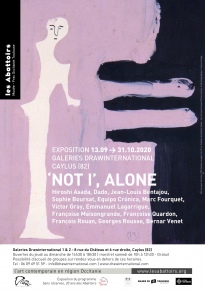
Exhibition - 'Not I', alone ‘Not I’, alone
Nothing exists in isolation, all art works reference other modes of expression.
In the monologue ‘Not I’ by Samuel Becket, ‘Mouth’ appears to be listening to an inner voice unheard by the audience.
The works selected for this exhibition echo numerous influences unseen by the viewer.
|
 |
||
|
September 2019
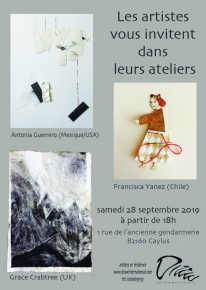
Open Studios This saturday artists in residence Francisca Yanez (Chile), Antonia Guerrero (Mexico/USA) and Grace Crabtree (UK) open their studios to the public. You are invited to see and discuss their work with them.
|
 |
||
|
July 2019
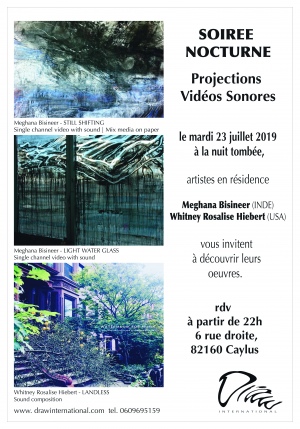
EVENING EVENT Soirée Nocturne Having responded to our call for applications 'Exile, Migration and Foreignness' in connection with the current exhibition Odyssées, this Tuesday evening July 23 as night falls , we will project the works ''LANDLESS' by Whitney Rosalise Hiebert (USA), ''STILL SHIFTING' and 'LIGHT WATER GLASS' by Meghana Bisineer (INDIA) artists in residence at DRAWinternational.
|
 |
||
|
July / August/ September 2019
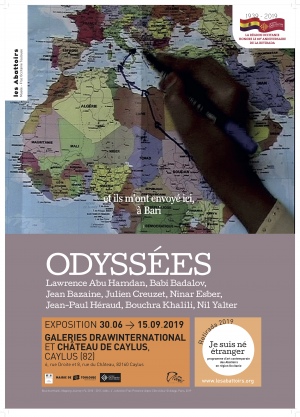
EXHIBITION - ODYSSEES Odyssées Lawrence Abu Hamdan, Babi Badalov, Jean Bazaine, Julien Creuzet, Ninar Esber, Jean-Paul Héraud, Bouchra Khalili, Nil Yalter An exhibition trail of contemporary art at three sites within in the town of Caylus The stories related to the Retirada are all the more vivid in the department of the Tarn-et-Garonne. The fact that it became a hub for Spanish republican exile, with the presence of the ‘Camp of Judes’ where from 1939, 16,000 Spanish refugees were held, had a huge impact on the municipality of Septfonds. It has upheld its memory and conserved paintings created either at the site or just after the release of the internees. Not far from there, in Caylus, several sites host exhibitions revealing contemporary stories of exile mixing poetry, song, photography, film and installation. The artists featured in Odysseys articulate a personal story with the collective story. Their visual art practice, based on language, bids the question: who speaks, who writes the stories? JE SUIS NÉ ÉTRANGER - Programme d'art contemporain des Abattoirs en région Occitanie
|
 |
||
|
April 2019
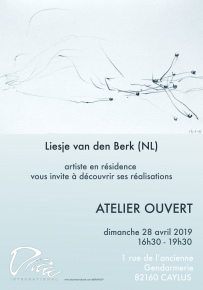
Open Studios This Sunday artists in residence Liesje ven den Berk (NL) and Julianne Allcorn (AUS) open their studios to the public.
|
  |
||
|
April 2019
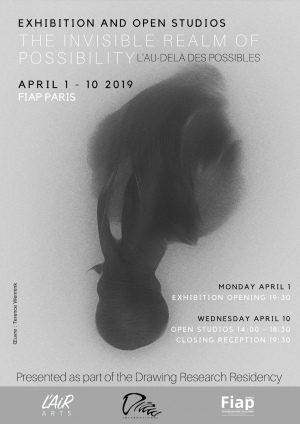
Exhibition : The invisible realm of possibility / L'au-delà des possibles Presented as part of the Drawing Research Residency in partnership between L’AiR ARTS at FIAP Paris and DRAWinternational, Caylus, France.
The artist, in the true meaning of the term, takes the viewer into a realm of an experiential space which may challenge and even alter a state of mind.
“Art does not reproduce the visible; rather, it makes visible.” Paul Klee The residency at DRAWinternational, Caylus focuses upon notions of intention and the physical act of drawing as it arrives as a vectorial force on a material surface. One could say, an infrastructure from where other possibilities collide, from common habitual behaviours toward the realm of the unknown.
The invisible realm of possibility / L'au-delà des possibles
Kate Arthur, South Africa Khushbu Patel, India Alka Dass, South Africa Terence Wennink, France Dr. John McNorton, a former visiting professor at the Royal College of Art in London and Head of Centre for Art and Design Education at the University of Wales Institute Cardiff, will give an opening presentation to the exhibition.
The Drawing Research Residency program is two-fold: a full month of creative practice in Caylus, followed by two weeks in Paris for contextual research and exploration, while exhibiting the work.
|
 |
||
|
December 2018
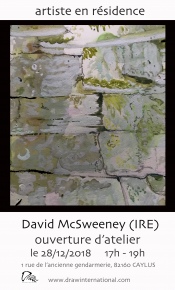
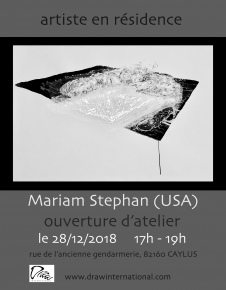
Open Studios Artists in residence David McSweeney (IRE) and Mariam Stephan (USA) open their studios to the public.
|
  |
||
|
November 2018
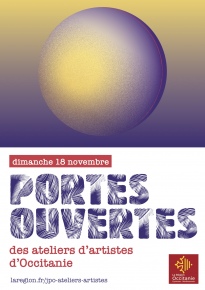
'OPEN DAY' - artistes studios in Occitanie DRAWinternational studios will be open on Sunday 18th November as part of the regional event inviting artists in Occitanie to open their studios to the public. You will be able to see the work of our three artists in residence and have the opportunity to chat with them : David McSweeney Ireland/UK, Lynn Imperatore USA/UK et Mariam Stephan USA, Aswell as visit John and Grete McNorton's studios Opening times : 10h30 à 12h 30 et 14h30 à 18h 1 rue de l'ancienne gendarmerie et 8 rue du château, Caylus. tel: 0609695159
|
 |
||
|
September 2018
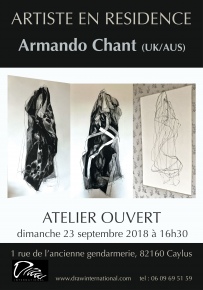
AiR - OPEN STUDIOS Armando Chant (UK/AUS) artist in residence at DRAWinternational during the months of August and September invites you into his studio. Join us for the opportunity to meet the artsist and discover his work. Sunday the 23rd of September at 4,30pm. 1 rue de l'ancienne gendarerie, Caylus 82160.
|
 |
||
|
September/October 2018
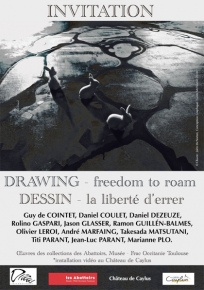
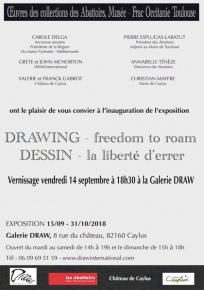
Exhibition : DRAWING - FREEDOM TO ROAM The extended notion of drawing is exciting and its methods and materials continue to intrigue and stimulate creative action in the postmodern world. DRAWinternational presents an exhibition celebrating drawing, the beginning of a fascinating and continuous collaboration with Les Abattoirs, Musée - Frac Occitanie Toulouse and the Château de Caylus. Guy de Cointet, Daniel Coulet, Daniel Dezeuze, Rolino Gaspari, Jason Glasser, Ramon Guillén- Balmes, Olivier Roi, André Marfaing, Takesada Matsutani, Titi Parant, Jean-luc Parant, Marianne Plo. These chosen works reveal a diversity and an appeal to us as an indication of the seed of an idea, some executed with speed and profundity, while other pieces, equally well rooted, examine and celebrate the joy of the durational act of drawing, its process and meaning.
|
  |
||
|
August 2018
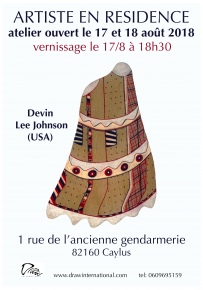
AiR - OPEN STUDIOS To celebrate the end of his two month residency at DRAWinternational, Devin Lee Johnson (USA) invites you into his studio to discover her drawings. On Friday the 17th and Saturday the 18th of September at 6,30pm. 1 rue de l'ancienne gendarmerie, 82160 Caylus. An aperitif will be served and you will have the chance to meet all our artists in residence.
|
 |
||
|
June 2018
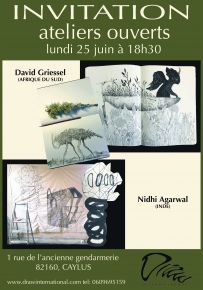
AiR - OPEN STUDIOS To celebrate the end of their artist in residency programme, artists David Griessel (South Africa) and Nidhi Agarwal (India) invite you into their studios. Monday 25th June at 6,30pm.
Do come and join us for a chance to meet the artists, discover their work and share an aperitif.
|
 |
||
|
March 2018
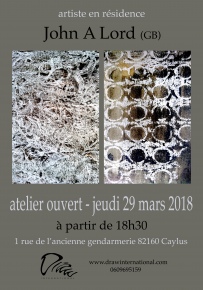
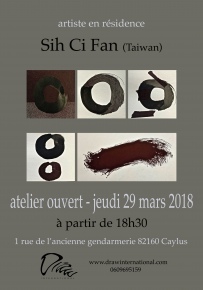
AiR - OPEN STUDIOS To celebrate the end of their artist residency at DRAWinternational, artists John. A. Lord (UK) and Sih Ci Fan ( Taiwan) invite you into their studios. On Thursday 29th of March from 6,30pm. Join us for a moment of discovery and exchange.
|
  |
||
|
January 28th 2018
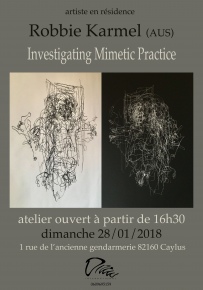
AiR - OPEN STUDIOS
A new year of exploration : research, projects and artists in search of fresh approaches to drawing.
On Sunday, January 28th at 4:30 pm - artist-in-residence Robbie Karmel opens his studio. Come and join us for a moment of discovery and friendly exchange, 1 rue de l'ancienne gendarmerie, 82160 Caylus. An aperitif with the artist will be served. John and Grete Mc.
|
 |
||
|
November 2017
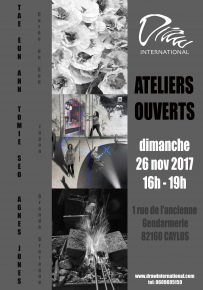
AiR - OPEN STUDIOS It's the end of the year!
The last Open Studios at DRAWinternational for this year 2017, artists Tae Eun Ahn (South Korea), Tomie Seo (Japan) and Agnes Jones (UK) invite you into their studios to see their works.
Do come and join us to discover, exchange and celebrate drawing in all its forms.
|
 |
||
|
August 2017
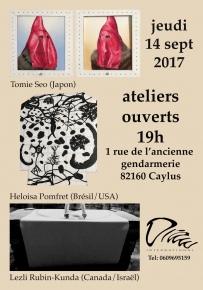
AiR - OPEN STUDIOS To celebrate the end of their artist residency at DRAWinternational, artists Heloisa Pomfret (Brésil /USA) et Lezli Rubin-Kunda (Canada/Israël) invite you into their studios. Tomie Seo (Japon), artist in résidence at DRAW in 2014, has come back, she will be in residence until the end of november, you can see the beginnings of her work and she will be happy to chat with you. Thursday 14th September at 7pm. Join us for a moment of discovery and exchange.
|
 |
||
|
July 2017
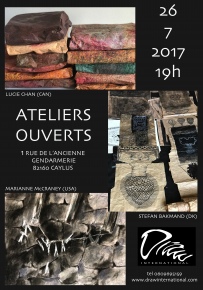
AiR - OPEN STUDIOS To mark the end of their residency programme at DRAWinternational, Caylus artists Lucie Chan (CAN), Stefan Bakmand (DK) and Marianne McCraney (USA) invite you into their studios on wednesday 29 july at 7pm Come and join us, a chance to see the work, chat with the artists and enjoy a glass or two! 1 rue de l'ancienne gendarmerie, 82160 Caylus.
|
 |
||
|
June 2017
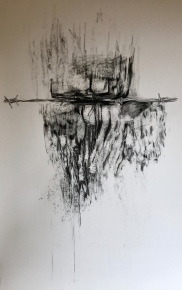
ARTIST IN RESIDENCE - HANA SHOUP (USA) Studio practice
|
 |
||
|
May 2017
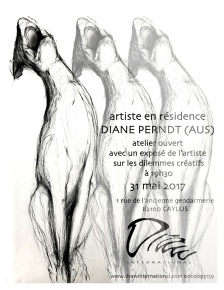
AiR - OPEN STUDIOS Artist in residence Diane Perndt (AUS) opens her studio to the public, come and hear her presentation on creative dilemmas, see her work and exhange ideas. Wednesday 31 may at 7.30pm
|
 |
||
|
March 2017
AiR - OPEN STUDIOS Artist in residence Tatjana Buisson (South Africa) opens her studio to the public, come and see the culmination of two her month residency at DRAWinternational.
|
 |
||
|
November 2016
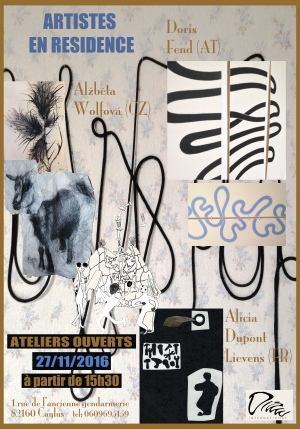
AiR - OPEN STUDIOS Artists in residence Doris Fend (Austria), Alicia Dupont Lievens (France) and Alžběta Wolfová (Czech Republic), invite you into their studio spaces. Sunday 27th November from 3,30pm. Come and meet the artists, see their work and share a glass of mulled wine! 1 rue de l'ancienne gendarmerie, 82160 Caylus.
|
 |
||
|
October 2016
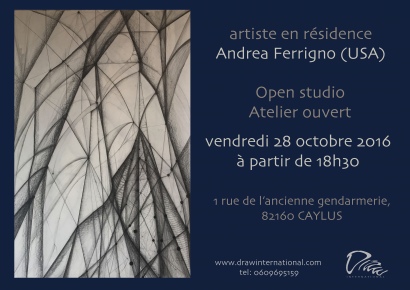
AiR - OPEN STUDIOS To celebrate the end of her one month residency at DRAWinternational, ANDREA FERRIGNO invites you into her studio to discover her drawings. Friday October 28th from 6.30pm 1 rue de l'ancienne gendarmerie, 82160 Caylus. Also in residence are ALZBETA WOLFOVA (Cz), DORIS FEND (AUT), ALYS ROSE GREEN (UK) Do come and join us for a chance to meet the artists, discover their work and share an aperitif.
|
 |
||
|
October 2016
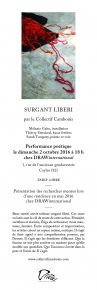
AiR - RESIDENCY RESTITUTION POETIC PERFORMANCE 'Surgant Liberi' The collective CAMBOUIS, present their research developed during their residency at DRAWinternational during the month of May 2016. Melanie Gabu - Installation Thierry Sterckval - Fretless basse Sarah Turquety - Poetry and vocals Sunday 2nd October at 6pm. 1 rue de l'ancienne gendarmerie, 82160 Caylus. An aperitif will be served and you will have the chance to meet all our artists in residence.
|
 |
||
|
September 2016
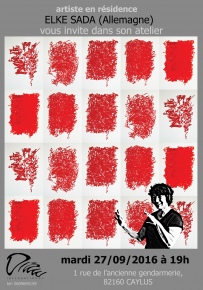
AiR - OPEN STUDIOS To celebrate the end of her two month residency at DRAWinternational, Elke Sada (D) invites you into her studio to discover her drawings. Tuesday September the 27th at 7pm. 1 rue de l'ancienne gendarmerie, 82160 Caylus. An aperitif will be served and you will have the chance to meet all our artists in residence.
|
 |
||
|
August 25th 2016
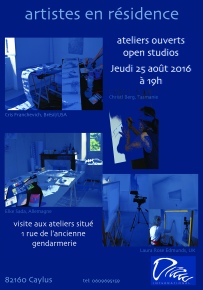
AiR - OPEN STUDIOS
|
 |
||
|
28 July 2016
AiR - OPEN STUDIOS
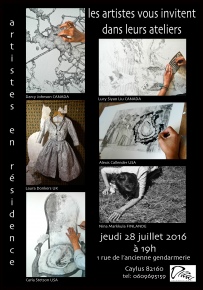
DARCY JOHNSON (CAN), LUCY SIYAO LIU (CAN), LAURA DONKERS (UK), ALEXIS CALLENDER (USA), NINA MARKKULA (FINLAND), CARLA STETSON (USA). Thursday 28th July at 7pm
Do come and join us for a chance to meet the artists, discover their work and share an aperitif.
|
 |
||
|
June 2016
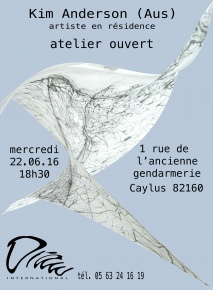
OPEN STUDIOS To celebrate the end of her three month residency at DRAWinternational, Kim Anderson (Aus) invites you into her studio to discover her drawings. Wednesday June the 22nd at 6,30pm. 1 rue de l'ancienne gendarmerie, 82160 Caylus. An aperitif will be served and you will have the chance to meet all our artists in residence.
|
 |
||
|
April 2016
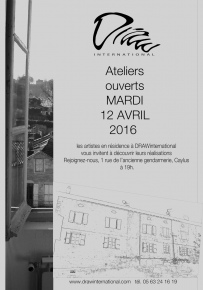
OPEN STUDIOS Here we go, the start of our AiR programme 2016! Open studios -Tuesday 12th of April at 7pm 1 rue de l'ancienne gendarmerie' 82160 Caylus Do come and join us for a chance to meet the artists, discover their work and share an aperitif. ANASTASIJA KOMARNYCKYJ (AUS), CAROL SMITH (UK), EMILIA RINALDINI (USA)
|
 |
||
|
Octobre 2015
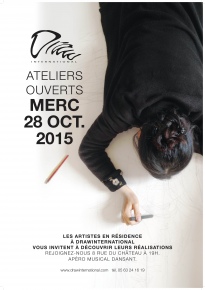
OPEN STUDIOS AND LIVE MUSIC Its the end of the season - so make the most of it ! Our last artists in residence are opening their studios on Wednesday the 28th of october at 7pm Rdv : 8 rue du château, 82160 CAYLUS. There will be drinks, music and dance. Looking forward to seeing you soon
|
 |
||
|
September 2015
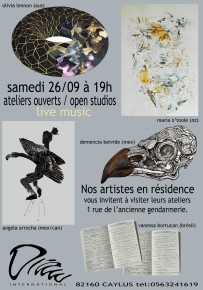
OPEN STUDIOS AND LIVE MUSIC This Saturday 26th September at 7pm - 5 artists in résidence open their studios situated '1 rue de l'ancienne gendarmerie'. We are very pleased to have a group of musicians - flute, saxophone, bass guitare and drums. Please come and join us for an evening of discovery and exchange. An apéritif, in the company of the artists, will be offered to you.
|
 |
||
|
August 2015
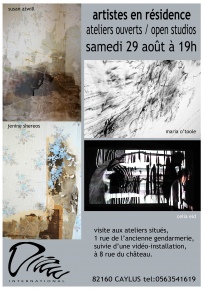
OPEN STUDIOS - ARTISTS IN RESIDENCE Saturday 29th of June, four of our artists in residence open their studios to the public. DRAWING and VIDEO INSTALLATION The visit will start at our new studios n°1, rue de la'ancienne gendarmerie and continue with a video installation at n° 8 rue du Château, 82160 Caylus. To follow an aperitif will be served in the terrace, where you can meet and chat with the artists.
|
 |
||
|
June 2015
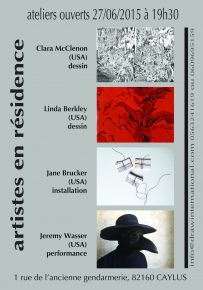
OPEN STUDIOS - ARTISTS IN RESIDENCE This saturday 27th of June at 7,30pm - four artistes in residence open their studios to the public. DRAWING - INSTALLATION - PERFORMANCE The evening will start at our studios situated '1 rue de l'ancienne gendarmerie' followed by a tour of the village 'science, sorcery - medecin and magic' and end at our studios 8 rue du Château. Come and join us for an evening of discovery and friendly exchange.
|
 |
||
|
June 2015
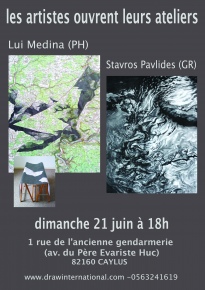
OPEN STUDIOS - ARTISTS IN RESIDENCE - LUI MEDINA (PH) - STAVROS PAVLIDES (GR) The studios will be open from 18h.
|
 |
||
|
May 2015
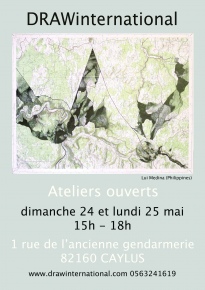
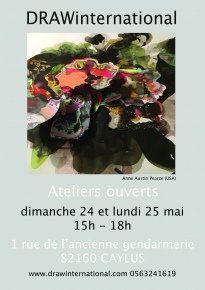
OPEN STUDIOS - ARTISTS IN RESIDENCE DRAWinternationals studio's at the 'Ancienne Gendarmerie Nationale' will be open to the public on Sunday 24th May and Monday 25th May from 3pm - 6pm. You are invited to come and chat with the artists in residence and discover their creative practice.
|
  |
||
|
March 2015
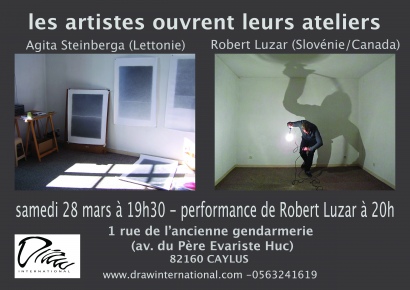
OPEN STUDIOS - ARTISTS IN RESIDENCE - ROBERT LUZAR - AGITA STEINBERGA To celebrate the start of our 2015 Artist in Residence programme and inaugurate our new studio spaces, Robert Luzar and Agita Steinberga will present their work to the public. The studios will be open from 7.30pm and at 8pm there will be a performance piece by Robert Luzar.
|
 |
||
|
Septembre 2014
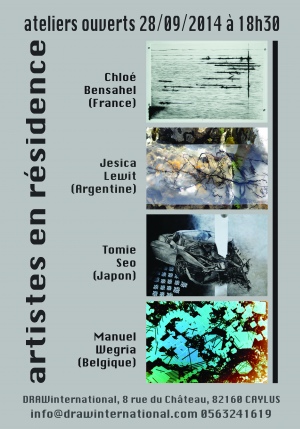
OPEN STUDIOS Artistes in Residence, Chloe Bensahel, Jesica Lewit, Tomie Seo and Manuel Wegria, open their studios to the public.
|
 |
||
|
September 2014
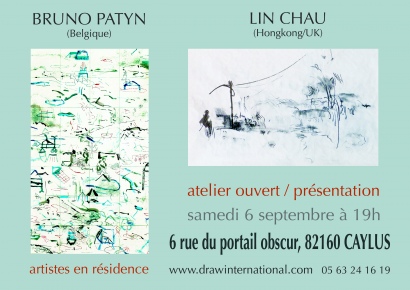
OPEN STUDIO - ARTISTS IN RESIDENCE - BRUNO PATYN - LIN CHAU Often a drawing or a work of art in general is seen as a means of communication between the artist and the spectator, but my drawings are not conceived in that way. When I am painting I have a conversation with myself through the painting and the moment I cannot take the conversation any further, the work is done. My process of painting is therefore a non verbal way of thinking, placed in a visual framework. The painting helps me to structure the work I am doing inside myself, as a work of integration. I bring parts of myself to the surface and integrate them in my full being. The drawing is not trying to deliver any message, reach out to the world, or express my deepest emotions to an anonymous spectator. I am merely thinking out loud. That doesn't mean another person can't have a conversation with that same painting, it will just not be a conversation with me. The end result of the drawing is not the drawing, but the endless possibilities of thought and conversation that may arise through it, and the excuse of gathering here and bringing people together. Bruno Patyn Drawing is a core element of my work. Due to its availability, I have been using white drawing paper in most of my past work, but recently I am drawn to using rice paper more and more. I like its semi translucent and subtle quality. The ink seeps deep into the paper and they become one. This makes mark making exciting. It is these qualities that attract me, and less of the conventional Eastern artistic style. However, once these materials are used, they are immediately seen as Asian style work even though the subject matter is not based on Eastern philosophy or principles. This led me to become interested in the significance of material and explore different ways of making work that might bypass reliance on one’s judgement on material’s historical and social context. This drawing residency has become part of my research. Lin Chau
|
 |
||
|
July/August 2014
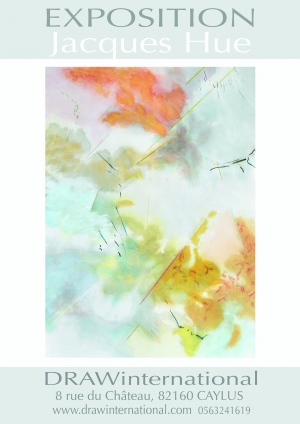
EXHIBITION - ESPACES DE MUSIQUES - JACQUES HUE Music has played an important role in Jacques Hue's life and artistic practice. It has become an every day necessity. Jacques encounter with the composer Roger Tessier in 2007 was instrumental in relation to his future work. He devoted two years to a body of work that was a direct response to the music of Roger Tessier exploring various approaches to sensorial mark making, in different media, palette and form to produce over sixty drawings and paintings. As a result of this process of analysis and synthesis, Jacques felt the need to further this research and approached other musicians for example Jean Yves Bosseur, Pierre Boulez… He also explored other musical genres such as Ravi Shankar (India), medieval music, Mozart (Requiem) and a variety of Asian music. This initial enquiry led him to work which began to evoke his own inner sonic sensory feelings. His is a universe of vibration, sound, colour, rhythm and form. Jacques Hue's paintings reveal 'musical spaces', they are the fruit of an in depth study, a response to diverse sources which reflects an inner and outer world of sensory experience.
|
 More images >> |
||
|
July 2014
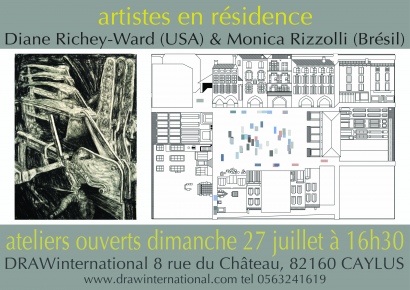
OPEN STUDIO - ARTISTS IN RESIDENCE - DIANE RICHEY-WARD & MONICA RIZZOLLI My recent drawings represent an ongoing series entitled, “La Vitesse de l’Idee”, which investigates the potential of drawing mechanical imagery. By layering structural elements of French farming machinery, I find an unlimited source of configurations: ideally dramatic and anthropomorphic in nature. I have a continuing interest in line, and how it relates to motion and energy in a work of art. I attempt to create an environment where the vigour, or force created by the form is retained in the piece. By seeking a delicate balance between improvisation and resolution my goal is to retain a certain mystery and an unpredictable outcome. These drawings are created through a build-up of charcoal and pastel images on paper - with an search for a certain reverberation between layers. Diane Richey-Ward I am developing a series of drawings written in Processing computational language and executed on the Java platform. The processing language permits the insertion of random variables on the code, making the drawings slightly different each time the program runs. Each drawing represents one specific geographic coordinate and a specific time based on my personal experience of the space. By adding objective and subjective data, historical information, a textual narrative, movement and the code itself, I intend to create an approximation between the map that I am drawing and the territory that I perceive. This work continues my previous research, which investigates the interrelationship between three concepts: the social and physical space; the individual perception of the space, and the representation of that space. Monica Rizzolli
|
 |
||
|
June 2014
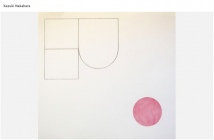
Kazuki Nakahara - Finalist FID 2014 Kazuki Nakahara - Artist en Résidence at DRAWinternational 2011, is a finalist of FID - International Drawing Prize for Young Artists 2014. His works will be exhibited at the Catherine Putman gallery In Paris in June 2014. FID PRIZE is an international competition dedicated to contemporary drawing. 15 candidates were selected among 300 for the nominees exhibition at The Drawing Box gallery in April. Now 3 among the 15 are selected for the finalists exhibition at Catherine Putman gallery: Camille Benarab-Lopez, Kazuki Nakahara et Tsama Do Paço And the jury’s special mention goes to Hajime Yamada. The opening will take place on Thursday June 19th 2014 from 5 to 7 4 pm at Catherine Putman gallery in Paris.
|
  |
||
|
July/August 2014
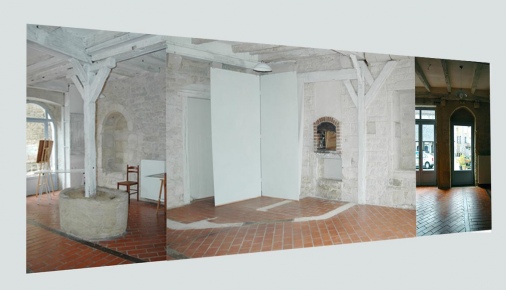
DRAWING + DRAWinternational - OUTREACH PROGRAMME DRAWING + I believe in an ecology of the imagination. I believe in a social ecology and cultural contributions which enhance the quality of life through artistic activities. Conflict and aggression are not intrinsic to humanity, they are reactive and constructed behaviours. I dream of a village that is tolerant and diverse, with an exchange of innovative ideas leading to a fuller more worthwhile and stimulating environment. We can determine our destiny and our environment. We know what needs to take place. Artists are invited to respond with a proposal for a one or two month residency to encompass drawing with another medium. We are looking for individual and collaborative projects and can accommodate up to eight artists. Please contact us for application procedure and fees.
|
 |
||
|
May 2014
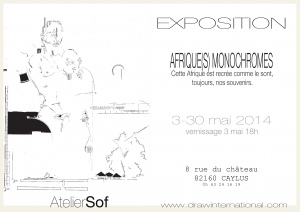
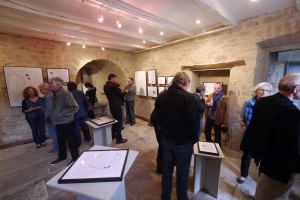
EXHIBITION - AFRIQUE(S) MONOCHROMES - ATELIER SOF Behind the workshop 'Atelier Sof' lies a painter. A childhood spent in West Africa, where most of his family stretching several generations were born and have lived. As a child, he discovers Senegal; he travels; he spends endless hours with his father cutting, pasting, and editing 8mm film. He browses over tiny images, studying them one by one, and placing them end to end. Bush village; portraits. Family legends: his grandfathers, Ubangi-Chari or Kayes. Adolescent he arrives in France. Fails to achieve a place at Art School. He works, travels, draws, and writes. He trains as a typographer. He starts to investigate new typography and ways of evolving the concept of 'the book' 2011: first works Afrique [s] monochrome. Memory; time; space and absence ; a sign, a line, reading; the search for a presence. stephanefelix60.wix.com/ateliersof
|
  More images >> |
||
|
April 2014
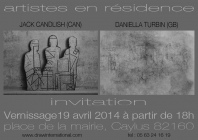
OPEN STUDIO / EXPOSITION ARTISTS IN RESIDENCE - DANIELLA TURBIN (UK) AND JACK CANDLISH (CAN) My work is a site responsive investigation of the synthesis of the physical and psychical perception of the world through the activity of drawing. My drawings investigate the threshold of abstract and physical architecture to include the joining of space, as characterised for example, by staircases, passage ways and roads which in turn combine to form impossible and paradoxical intertwined space. Daniella Turbin My drawings reflect an exploration into reciprocal nature, that being the relationship between an individual and the environment. As humanity reshapes the physical environment it inhabits, so does the environment shape the way in which we think. The worlds shifts and changes and in turn so do our interpretations and interactions. Jack Candlish
|
  More images >> |
||
|
September /October 2014
Is your creative practice predominantly drawing ? Communication through drawing - A residency for artists, writers and musicians. Owing to a recent cancellation. We have one available residency space for September /October 2014 at DRAWinternational. We are interested in an artist who has an open minded and experimental approach to drawing. We invite you to take a look at the works to date on our website and make a proposal which offers a dimension not yet represented. We look forward to your proposals. The Board of DRAWinternational.
|
 |
||
|
October 2013
ARTIST IN RESIDENCE - SUSAN WALSH (USA) 'The change in shadows due to the earth's rotation is the single most important indicator that time is passing. Consequently, noting changes in color of daylight and in the cast of shadows is the most reassuring means we know to mark the movement of time'. Leonard Shlain, in Art and Physics One of the most persistent dialogues in my work as an artist, is between loss and the visual evidence of the passage of time. Each visual image becomes a Memento Mori of time and spaces in transition. In the altered dimension of grief, after one suffers the pain of the loss of a loved one, one's relationship to time is reassessed: time feels too long, or it feels too short, or it seems to stop moving. One waits for signs: the mysterious and ultimately reassuring alchemy of time, presence, and form. I would like to wait for signs during this residency and produce a physical manifestation (drawings), of that waiting. Susan Walsh
|
 |
||
|
September 2013
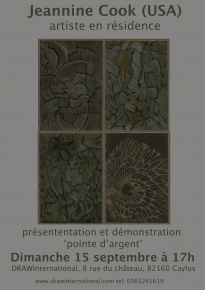
ARTIST IN RESIDENCE - JEANNINE COOK Presentation and demonstration - Silverpoint As a child in East Africa, I spent endless hours in a darkroom with my photographer grandfather, watching black and white photographs appear, as if by magic, in developing trays. Their monochromatic beauty ultimately contributed, I now realise, to my fascination with the drawing medium of silverpoint. Drawing with sterling silver is demanding. The medium develops slowly, like a black and white photographic print. Its intensity of execution allows me to concentrate on the familiar. I reaffirm connections with my sense of place, with rhythms of tides and seasons, with light moving, changing, transforming everything. For me, silverpoint is a subtle, quiet medium that provides a counterpoint to today’s high voltage world. Perhaps that is not surprising, given that this medium, known generically as metalpoint, was born in the contemplative atmosphere of 12th century European monasteries. Silverpoint allows me a shimmering dialogue with my surrounding world.
|
 |
||
|
September/October 2013
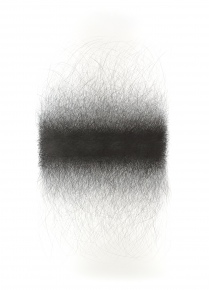
ARTIST IN RESIDENCE - SANDE WATERS (CANADA) I have two bodies of current work which have a predominant theme referencing iconic female symbols. My large drawings are conceptual visual metaphors of female bodies. One of my drawings was five feet high by thirty feet long and required repetitive gestural mark making, taking several months to complete. To me, the physical and emotional environment one experiences results in choreography of unique gestures that may seem meaningless, and often we are not conscious of them, but they actually create form that defines who we are. My smaller more recent drawings are a study of rather engaging and playful ‘Goddess’ symbols. www.sandewaters.com
|
 |
||
|
August 2013
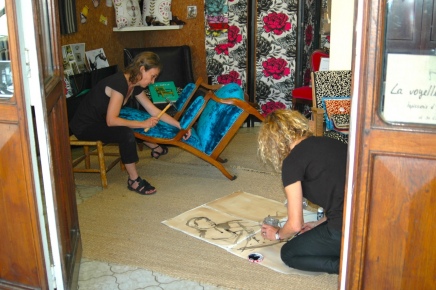
ARTIST IN RESIDENCE - BARBIE KJAR (AUSTRALIA) A Tasmanian artist in Quercy "During the residency at DRAWinternational in Caylus, France I am focusing on drawing portraits from life of seven people who live in Caylus and seven hand tools. In some cases I am drawing the portrait of the person involved in their work and interacting with the various tools of their trade. I have worked on drawings of Nathalie Céré in her atelier and in my studio. The images drawn in her atelier have focused on the act of upholstery. It appears to be a very physical craft which involves an almost sensual relationship with the chair. It is like a dance and struggle at the same time and a metaphor for human relationships- the push/ pull effect." Barbie Kjar - Article la dépêche 26/08/2013 http://www.ladepeche.fr/article/2013/08/26/1695394-caylus-barbie-kjar-une-artiste-tasmanienne-en-quercy.html
|
 |
||
|
August 2013
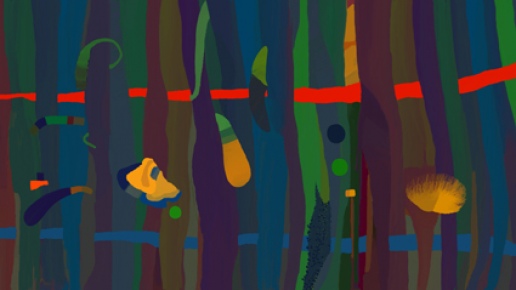
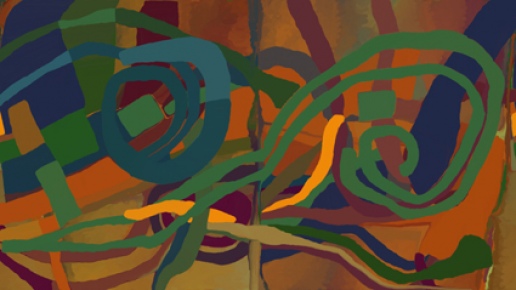
INTENSIVE DRAWING WORKSHOP - CELIA EID (BRAZIL) It is a little picture that lit a flame in my soul. A child lying on his back, on the ground, draws on a large white paper spread on the floor. His face is hidden by the legs of a wooden stool laid on the ground. His arms are behind his head. He is drawing a big round line. He draws many of them and he will certainly do a lot more. It looks like he doesn’t see what he is drawing. He and a friend fill the huge white paper on the floor with graphics. They have the face of the happiness. As soon as I saw this image on their net page, I sent an email to Drawinternational. I also want to learn how to draw from under a stool: this is my project. I am a digital artist. I create animations frame by frame on contemporary music. Still, sitting on a chair, eyes open, I draw on the screen’s restraint area. I fight, immersed in this virtual and immaterial world, against oblivion of my own body. Traditional expression techniques; painting, lithography, drawing, help me to fight against. Touch with the stone and ink made me come back to the world of sensible and gesture. I practice it all tirelessly and whenever I go back to my good old chair in front of the computer, I found my body recharged with energy of the 'real'. Celia Eid Celia Eid was born in Brazil and is currently based in Paris, France. She creates her animations using traditional stop-frame animation in the computer. While still living in Brazil, Celia Eid won awards for her work as an illustrator and graphic designer. In 1994 she published the graphic novel Penare. After training in digital media she worked for two years in post-production for television and then moved to France to pursue her activities in animation as an independent artist. She has created animations extensively for live music performance and often collaborates with composers and musicians. Since 2005 her works have received repeated presentations at many international festivals. The Stool workshop The photograph alluded to and the aim was: ‘simply to ‘discover new dynamics i.e. relationships//mutuality/difference/influence in relation to previous workshop objectives for extended periods of time’ (PhD thesis- ‘The Choreography of Drawing’, 2003). The two students Emily Clark and Neil Davies were artists I had not worked with before. Drawing with an everyday inanimate object experimented with limitation and interference as a positive element to demarcate gestural acts within certain physical constraints. In so doing the stool become a trace of itself in relation to the body as it endeavoured to find form within this interactive relationship. The stool knows not what it does while existing in the space of a body which can only act in a partially non knowing way. This experience helped the student artists collide with something challenging and stimulating, which on reflection nurtured other meanings and other methods for experimentation. In this way the drawing was for ever in the becoming, never quite arriving, yet still providing a perceptive record of a particular time and space. When one finds something new it invariably leads somewhere else equally as stimulating and at times deeper and more enduring. The workshop will experiment with the body in various situations and influences with drawing processes/ methods/ materiality which come as close as possible to the concept and intended nature of the time and space of each drawing to be made. It will explore notions of: duration, silence, gravity, repetition, limitation, collaboration, mass, sensory deprivation, scale, individual autograph/style. John McNorton 17- 6- 2013
|
    |
||
|
July 2013
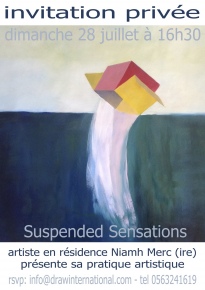
NIAMH MERC - Open studio/exposition As an artist, I have continuously used drawing as an expressive reaction to what I see and how I feel. My intention for this residency with Drawinternational was to struggle with being honest within my own artistic practice through working alone in the studio and being on a residency which also relies on objective discussion with other artists. With this practice of drawing as an emotive tool comes a continuous struggle to try to formulate and feel the abstract feelings that we all share when we think and dream about ourselves and others. Through opening up a public space it can help towards making sense of thoughts and feelings that are not realised, hidden, denied, misunderstood or not discussed in an objective manner. Niamh Merc
|
 |
||
|
July/August 2013
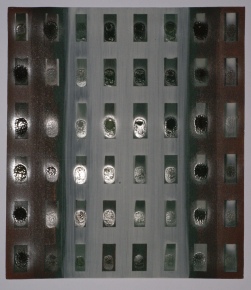
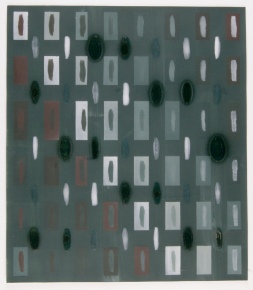
ARTIST IN RESIDENCE - ALISON GRAHAM (UK) 'DRAWING and CLAY' In July/August 2013 ceramic artist Alison Graham (UK) will be exhibiting her PhD research work and more recent experiments at DRAW international’s gallery and studios. She said in a recent correspondence: I was searching through the artist residency sites and came across yours and it brought back the most wonderful memories of my time in Caylus in October 2005 with the MA Ceramics from CSAD. It was truly a life-changing experience for me, as it sparked off an overwhelming enthusiasm for drawing and mark-making that has developed in my ceramic work over the past 8 years, through the MA and PhD. I just wanted to say thank you for your enthusiasm, encouragement, support and understanding. Alison's studio will be open to the public to give insight into her ideas and working processes, which clearly integrates drawing as a vital component to her overall creative practice. DRAWinternational are happy to introduce this funded residency opportunity which is the first of an annual award to an artist whose work promotes drawing in a contemporary context. http://www.aligrahamceramics.moonfruit.com/
|
  |
||
|
15th july 2013
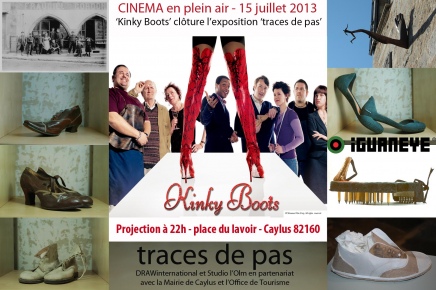
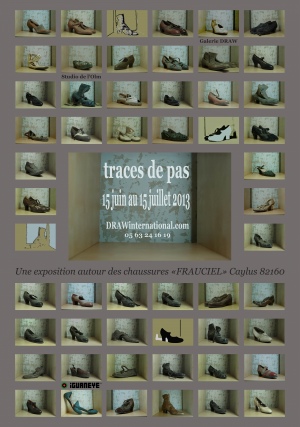
Open Air Cinema - Caylus 'Footprints' - 'traces de pas' The exhibition 'traces de pas' will close on the 15th of July with the projection of the film 'Kinky Boots'. When an exhibition celebrates the past and present through "the shoe". The discovery of a collection of shoes from the once shoe shop 'Frauciel' in Caylus was the inspiration for this exhibition - it explores art and craft , the traditional and the contemporary. This exhibition is like a work in progress, evoking memories, history and discussion. We would like to thank everyone who has contributed to this 'work'. We invite you to discover and share the experience. Kinky Boots is based on a true story, the film follows a traditional Northampton shoemaker who turns to producing 'fetish' footwear in order to save the failing family business and the jobs of his workers.
|
 |
||
|
July 2013
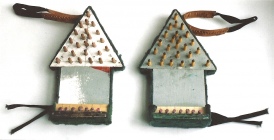
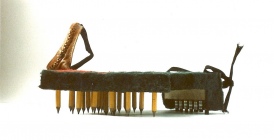
ARTIST IN RESIDENCE- NIAMH MERC (IRELAND) I am so pleased to have artist and teacher Niamh Merc as a resident artist next year. She was one of my MA students at Cardiff during 1996/7. I have included an excerpt from her thesis The Importance of Drawing as a Mathematical Expression, 1997 which I still find pertinent and two images of her finely made drawing shoes which formed part of her MA exhibition. 'Niamh Cooney's Pencil Shoes were used to record an action of movement with the feet which were pushed and dragged along the ground in an intentional movement "to think of form in terms of definite measurements" and to reduce "all proportions . . . to forms such as triangle, square, circle" (Klee, 1956, p.22-23). This intent is "a thought in act: it is in this sense that I am certain of myself" (Merleau-Ponty, 1964, p.22). The thoughts within the pencil performances make use of a tactile motion rather than seeing themselves.' Klee, Paul (1956), Klee. Volume I. The Thinking Eye, edited by Spiller, Jurg, Lund Humphries, London and Bradford Merleau-Ponty, Maurice (1964), The Primacy of Perception, Northwestern University Press
|
  |
||
|
June/July 2013
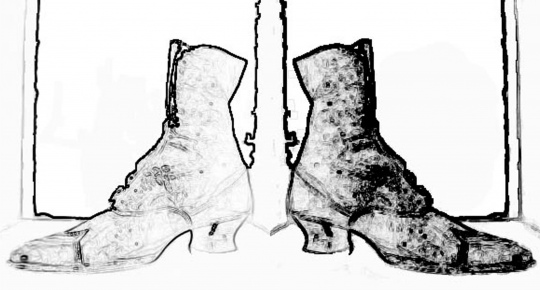
Exhibition 'traces de pas' John and Grete discovered the existence of a collection of shoes from the shop 'Chaussures Frauciel' at the bottom of rue droite opposite the church in Caylus. They have curated an exhibition around this collection which will take place in both their gallery 'DRAW' and at the 'Studio l'Olm' run by Eleonoor Klinkert et Steven Van Den Berg, in Caylus. Through a collection of shoes dating from early 1900, the exhibition 'traces de pas' will celebrate traditional and contemporary art and craft. Two exhibition spaces and two shop windows (one of which is the original shop 'Frauciel') will give an insight into the world of shoes by craftsmen, artists and a young designer. Why we're passionate about these shoes: The shoe shop Frauciel is part of our local heritage, a shop passed down from father to son with shoes that reveal craftsmanship and fashion over many years. Shoes for drawings that walk : DRAWinternational - Centre for research for contemporary drawing practice. Artist in residence Niamh Merc created shoes as a tool for drawing. Our encounter with a young local designer Olivier Taco who has created the "Iguaneye" an ultra-modern and ultra-minimal shoe. John's mother used to work at the shoe factory "Clarks" in Plymouth, UK. He grew up with shoes around the house, wear test samples for the company. Grete's first job 'a saturday job' whilst still at school was in 'Saxones' a shoe shop, she's been a shoe fan ever since. and in addition French women are the European champions for buying shoes (6 pairs per year) !! A celebration of the past and the present through objects, images and film. The exhibition will open at 7pm on June 15th and will close on July 15 with an open air cinema showing the film comedy "Kinky Boots" . For more information: tel: 0563241619
|
 More images >> |
||
|
April 2013
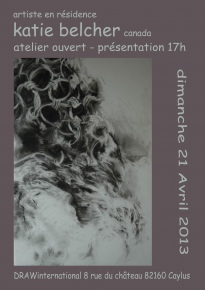
KATIE BELCHER - Open Studio/exposition My work at DRAWinternational is centred around the experience of plucking a bird for the first time, a pheasant. The awkwardness with which I completed this previously “routine” task, is the inspiration for a new drawing project. I’ve documented the process, and categorized and documented its trace—the feathers. I aim to describe the pheasant itself, as well as the action of plucking.
|
 |
||
|
April /May 2013
ARTIST IN RESIDENCE - VACANCY FILL THESE SHOES? This very late notice is because we have had a last minute cancellation for April/May 2013. We are now rescheduling and have an opportunity for May/June 2013. If you are interested please contact us at info@drawinternational.com to take up this fast track drawing opportunity.
|
 |
||
|
March 2013
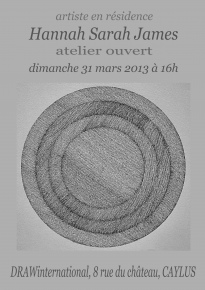
HANNAH SARAH JAMES - Open Studio My practice encompasses the gestural motion of the hand drawn mark, typically through site-specific drawings using thousands of straight lines.
|
 |
||
|
March 2013
HANNAH SARAH JAMES - (UK) Is your drawing practice primarily concerned with ideas of abstraction ? We are interested in an artist who has an experimental approach to drawing as abstraction, notation, repetition and/or geometry. We are pleased to announce that Hannah Sarah James has been selected to be our partially funded artist in residence for March 2013. ‘The mark-making potential of line has long been taken for granted and little consideration given to the mystery inherent in a simple line’ - Ziba Ardalan. ‘To the eye of the viewer the drawing objects, with their torn surfaces and empty spaces, crossed by lines and threads, are traces of a journey that point to the possibility of the existence of other planes. They suggest the existence of fullness in the empty.’ - Anna Maria Maiolino. My works explore the idea of obsession through mark making and the process of repetition through drawing. My research is predominantly process driven. I think through the making. A process of mark making that is made up of the repetitive building of lines and the continual reflection of this. This relates to the often site specific nature of my work. Space is essential within my practice; much of my work is developed through response to space, time and surface. Through drawing I have been able to develop a process that enables the viewer to feel emerged in the obsessive nature of the work and appreciate the time and the labour process. Exploring the physicality of the space the nuance and subtleties of that wall/ surface. Drawing attention to something that is largely overlooked and therefore the building itself becomes integral to the piece of work. The marks made are non-representational; they are an exploration of surface, a marking of time spent with a site and a demonstration of labour. This is also an attempt to slow the viewer down to appreciate the time spent to make this. This is my way of highlighting that this futile gesture does mean something, something slow and process based. The process of making acts, as a form of meditation, there is a sense of hypnosis involved in the repetition of the mark making and it is this meditative nature of the work that I want to translate to the viewer. Hannah Sarah James
|
-2) |
||
|
February/March/April 2013
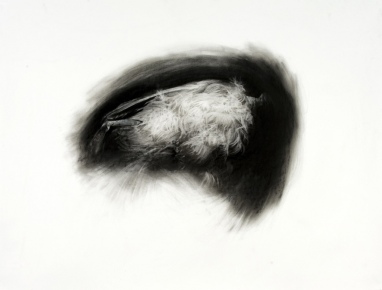
ARTIST IN RESIDENCE - KATIE BELCHER (CANADA) Through my artistic practice I have been exploring the ways in which humans process experience and build memory. I find drawing to be an effective medium through which to make these explorations. It is intuitive and evokes experience without defining it. My drawings are centrally composed, densely modelled and make significant use of erasure. Animated by the tonal variations and marks beyond their outer contours, the previously static subjects appear to be emerging from or dissolving into the white ground. Using my own experience, found objects and museum archives as a starting point, I exploit the image’s function as a mnemonic resource for myself and other viewers. My drawings examine experiences, how we record and remember them, and what we lose with time and progress. katiebelcher.com
|
 |
||
|
January/February 2013
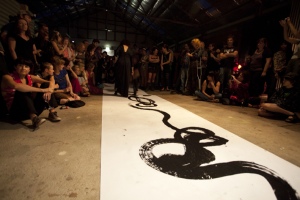
ARTIST IN RESIDENCE - KELLIE O'DEMPSEY (AUSTRALIA) DRAWinternational is an innovative and supportive location for contemporary arts practice. It is in this experimental and critical thinking environment I want to incubate my current performance drawing investigations. Exploring expanded drawing as documentation I aim to investigate notions of inhabitation and inclusivity via a site-specific performance practice. Kellie O'Dempsey Recipient Australia Council Artstart Grant
|
 |
||
|
October 2012
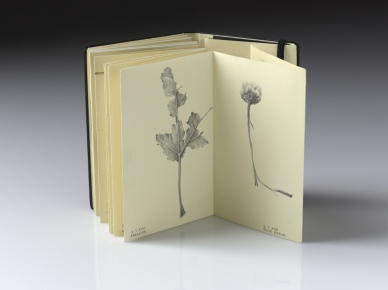
ARTIST IN RESIDENCE - JULIE PAYNE (AUSTRALIA) My initial training in the field of sculpture and architecture pushes this desired three dimensional approach to drawing as an object. Apart from producing a body of work that I would use in upcoming exhibitions in Australia, I would greatly enjoy the liaison with other artists to share ideas and techniques. www.juliepayne.com.au
|
 |
||
|
September/October 2012
ARTIST IN RESIDENCE - ANNA HAYES (UK) Highlighted in my oil paintings are the inaccuracies within Google Street View, exemplifying how our own perception of the world is so unlike that of a photographed image. What is at all is barely there, and in appearance what is; is beauty. My watercolour paintings in appearance have a documentary nature, but are conceived as a form of mapping a place or home, a combination of juxtaposed figurative element, which are then softened by imposing a careful simplification approach to the development of the work. Through this silencing process, disparate narrative images connect or stand alone, creating a subtle, calm, partially abstracted whole. Through the use of carefully selected figurative imagery I am exploring the function of the home, having a sense of place and belonging, together with ideas of remembering, perception and nostalgia. I have developed a calculated system of constructing an image that mirrors my thought process. The technique I employ allows me to reiterate the melding of identities into a unified whole. I build the paintings up using thin layers of dilute colour. By editing imagery I can draw attention to the peaceful moments that can perhaps go unnoticed. A duality exists both visually and conceptually within my work. Physically, it can be perceived as flat and decorative, yet a strong sense of serenity and composure also occurs created by the light tonal palette and the lack of detail. It is to allude to a sense of comfort, peace and sanctuary.
|
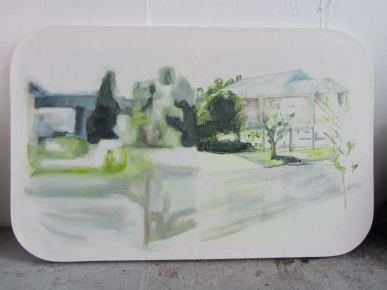 |
||
|
September/October 2012
ARTIST IN RESIDENCE - EVAN BROENS (CANADA) The theories presented by Goethe and his topic of intuitive consciousness as a way of understanding has become central to my working methodology. Drawing has operated as a grounding moment in my creative process and there are aspects of my practice and my work which includes drawing. Yet this way of working has not fully become a secure element in my portfolio. The DRAWinternational residency is an important opportunity to initiate drawing as its own entity in my practice, rather than being supplementary; bridging practice and theory and, as the website indicates, to locate a contextual framework. Evan Broens
|
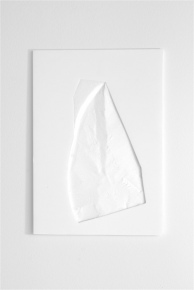 |
||
|
September 2012
ARTIST IN RESIDENCE - NONI BOYLE (CANADA) Since drawing is central to my practice, I was very excited to find a residency opportunity that seems to celebrate the act of drawing to the extent that DRAWinternational does. One of the reasons that I wish to do a residency in France has to do with the exploration of place, identity and belonging. My maternal family history has its roots in France (many generations past). I have not spent more than a few weeks in France prior to this, and would welcome the opportunity to stay long enough to absorb a sense of place and develop some work in response. Noni Boyle
|
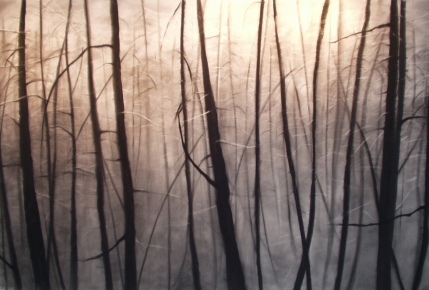 |
||
|
June 2012
ARTIST IN RESIDENCE - JULIA HITCHCOCK (USA) Objective Projects for me have always been the generative force that begs the next “what if?” “Next question, next inquiry, next body of work,” all manifest themselves in the active moments of working, coupled with the need to satisfy a visual conceptual puzzle. DRAWinternational has the structure and environment that will enable me to realize my next project: “the deconstruction and disintegration of the human form within its environment.” Visually describing the event of a human body actively chasing after its’ own basic cellular structures and acknowledging human existence as a non linear progression of events much like the firing of synaptic connections of nerve endings, the subtle act of a last breath or the jolting, violent surge of the last ounce of blood pressing against the interior lining of an exposed vein. These types of events ultimately lead to states of physical and spiritual transitions from one chemical or cellular state to another. It is this transition, interspace and state of being that I wish to elucidate in the large drawings. www.juliahitchcock.com
|
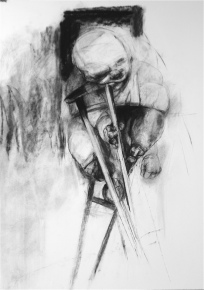 |
||
|
June/July 2012
ARTIST IN RESIDENCE - MIO HANAOKA (JAPAN) One of the biggest subjects of my works is how to grip relationships in durational time. I want spectators to feel that everything changes all the time, even now. All objects, including myself, are transforming in order to adjust ourselves to every present moment. We tend to look for a place to stay to make us comfortable, but there is nowhere to stay same. So, I’d like to show the variable present which contains a trace of past and also a smell of future. Mio Hanaoka
|
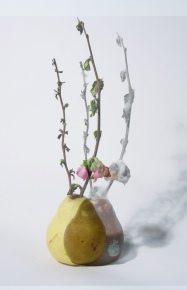 |
||
|
May/June 2012
ARTIST IN RESIDENCE - ANDREA POR (CANADA) The underlying theme of my work is informed by the human condition, i.e., the will to power and its subsequent effects of fear, doubt, anxiety and isolation. I am interested in these emotions and how they contend and relate to the enormity of the world and the ephemerality of life itself. What happens to my achievements and will to power after I die? Who will remember me? To what purpose does my individual will to meaning serve on a grand scale? Andrea Por
|
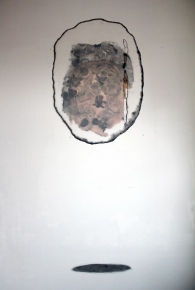 |
||
|
18 MARCH 2012
ARTIST IN RESIDENCE- ANOOK CLEONNE (HOLLAND) Open studio showing Anook's recent drawings at the centre.
|
  |
||
|
April/May 2012 (rescheduled)
ARTIST IN RESIDENCE - DAVID NECHAK (USA) David Nechak has taught for many years and exhibited extensively in the United States of America. He has also exhibited his quirky and humerous ideas in Canada, Ireland and Scotland. He continues to explore these ideas through installation and sculpture with continuing wit and integrity.
|
  |
||
|
September 2011-2012
Open Call - A Social Science and Art and Design Collaboration with Prof. Graham Button and Dr John McNorton Human beings think in the concepts of language, but how they express what they know transcends talking or writing. People perform actions and interact together in language but action and interaction is not confined to language. Therefore if we want to explore what and how people know things, the world we live in, and peoples' relationships to it and to each other we need to do this in modes of communication other than the conventional written form. Movement, colour, form are other ways to those of text and talk through which people can communicate with one another, or can be used in conjunction with one another to express what someone knows or wishes to convey. Consequently they can all be used to explore our world. This means that the traditional academic boundaries that separate art, human sciences and the natural sciences can hinder our understanding of our world and how we communicate that. We thus see that the meeting of minds from different disciplines is an open and dialectic opportunity for progress in the way we reflect upon and make reflective decisions about our world and how life actually might be at any particular time. Drawing for instance, is an activity which now is considered as an art form in its own right, yet can actually offer many variables in first order observation, which is, again traditionally thought of as the provenance of the human sciences, and in how one might convey these related reflective outcomes. Through breaking down the barriers between traditional disciplinary perspectives and through other creative opportunities, ideas can collide and may motivate fresh, energetic and rigorous exploration. John McNorton is an artist and educator who considers mind and body issues through the everyday and more conscious creative action. This world is not one encountered by the eye alone, but through the whole human interactive corporeal sensorium through which we are inexorably a part. This is a body for others, as it exists in its habitual state and focusses on how creative intervention can foster change in ones gesture to possibly result in new form. Graham Button is a sociologist whose interest in ordinary practical action and interaction is grounded in the relationship between mind and language. He has investigated how people reason about their world and display and use that reasoning in their interactional performances with one another in a diverse range of social settings. For the past few years he has focused upon how people reason about the work they do, and how that can be traded into the design of computer systems. These two seemingly disparate approaches have come together in reflections that have revealed mutual concerns and interests and provide opportunities to push the boundaries of traditional expression. Both John and Graham are committed in making some difference in how things are and towards how they might possibly be. It is the intention to research the content and methodology of a selected number of artists at DRAWinternational during their residency. Artist, therefore, who are willing to have their work and processes carefully scrutinised and discussed in preparation for publication can apply stating this in their application. A small selection of artists will be chosen during the 2012 according to the type of work produced and the availability of each person involved to mutually agreed dates. (Etching by Kazuki Nakahara, no title, 2009,19.5x24.5 cm)
|
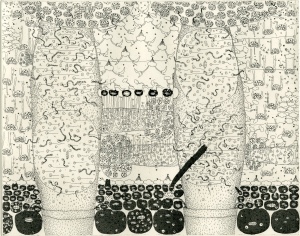 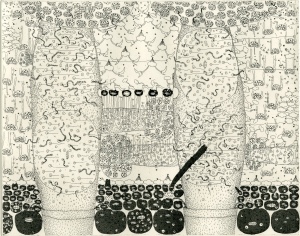 |
||
|
September/October 2011
ARTIST IN RESIDENCE - KAZUKI NAKAHARA (JAPAN) I am interested in 'Line'. I learnt Japanese calligraphy from my father who works as a professional Calligrapher in Japan. I learnt the strict rule of handwriting and expression from the different forms of Japanese characters. Sometimes I practised the same line all day long. This experience has influenced my interest to draw on paper. The drawings are made by adding repetitive strokes with a coloured pencil on paper. I form one or many circles which mostly symbolises the Woman with Pigtails. It is not only the humorous form which interests me, but also the long meditative process of drawing. Stroke by stroke, I try to repeat the line with the same quality with a consciousness in the act of drawing itself. I am also interested in making rules with simple mathematics in drawing. Some round forms stand in a straight line, some make a group with others or make a triangle and some go around regularly. So I amuse myself with the arrangement of motifs and try to express rhythms on paper. www.kazukinakahara.com
|
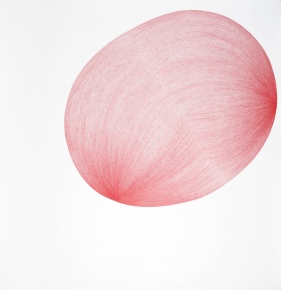 |
||
|
July 2011
ARTIST IN RESIDENCE - CHERIE BENNER DAVIS (USA) I propose to make works by chopping up and rearranging maps and world globes. These will be collected, some prior to arrival and others while in France (both in Paris and possibly also in the local villages near the residency site, if available). These works will reconsider relationships of the individual to place, space and current geopolitical events through a conflation of the physical and psychological systems used to map our world, lives and movement. The pieces will be reconfigured to become three-dimensional forms that mimic things like natural phenomena (ex. the shapes of hurricanes in motion), and the globes will be altered in various ways such as a rearrangement of the countries and continents and in ways that distort/destroy their usually round form. Source materials that are France-specific like Paris metro maps for instance, might be reconfigured to relate specifically to the approaches to map-making, and concepts of locus, space, and movement there. Cherie Benner Davis
|
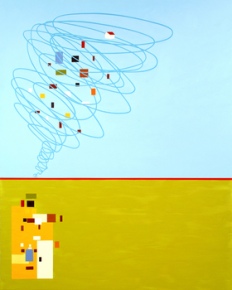 More images >> |
||
|
June 5th, 2011
Open studio / Building walls on paper - SARA SCHNECKLOTH (USA) These drawings emerge from discovering the manmade and natural terrain of the region around Caylus. In particular, I have been attracted to the many dry stone walls that mark the area. The walls carry a sense of structure, layering, stability, and grace, qualities that I believe can translate from three dimensions to two, and back again. In an effort to understand the labor and tradition of stone wallbuilding, I spent two days helping with a group (APICQ) to rebuild a length of dry stone wall in Jonty. Whether working with a large stone to find the most satisfying fit, or gathering pebbles to fill and fortify, I found that the concerns of the wall translate directly into the activity of drawing. Whether using stone, ink, or charcoal, the character of the materials suggests technique. The process of intuitively finding and placing stone after stone mirrors how a drawing builds, mark by mark, with the structure evolving over time and patient labor. Working between the wall and the studio also gave insight into ideas of collaboration and ownership, as each individual's labor became a part of the larger structure, an accumulation of effort, intention, and technique. When I set to build walls on paper, using drawing materials instead of stone, I found that the same concerns were central. What does the wall need to become stable? What mark will fortify the whole? How do layers build in space, through touch and intuition? The utility of the drawn wall differs from that which separates pastures or marks property, but the drawing works as a record of labor and experience, a puzzling over structure and balance, and a hopeful pursuit of integrity. Sara Schneckloth
|
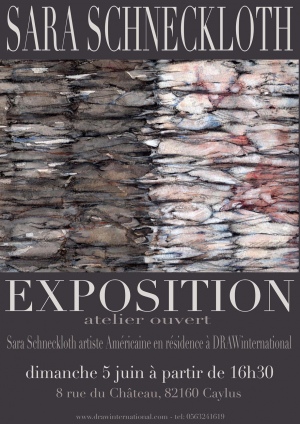  |
||
|
May/June 2011
ARTIST IN RESIDENCE - SARA SCHNECKLOTH (USA) How do we hold memory? How do memories hold us? I pose these questions as the starting point for my work, as I strive to embody moments of remembering, and consider the relationship between the body’s physical performance of memory and inscriptive practice. My work deals primarily with imagined microbiological systems rendered on a macro- scale. I envision and create cells, organs, fluids, and tissues, and seek to assemble the elements into new systems of organic relationship and connection. I work in a variety of mediums and look for ways to take drawing beyond its traditional definition of “mark on paper.” I believe that the act of drawing is a way of residing in multiple states of awareness – of present, past, future – of what one is, has been, and hopes to become – of the physical, the mental, and the formal. I draw as a way to see more deeply, both inside and out, and to elevate the act of seeing to a process that is fully engaging of both body and mind. In the gesture of a drawing, there abides the question of how human beings hold memory. I care about how the body holds its history, and how that recollected history can be performed through the act of making embodied signs. Sara Schneckloth teaches drawing and critical practice at the University of South Carolina in Columbia. www.saraschneckloth.com
|
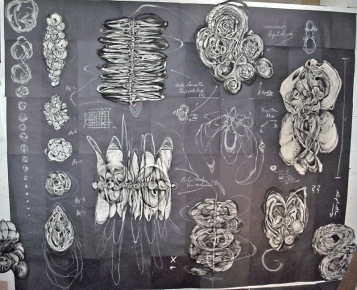 |
||
|
April 16 - May 21st, 2011
Exhibition - Digital Dialogues JASON DAVIES/DARREN WILLIAMS (WALES) The origin of this collaboration was borne out of the desire to be more creative with electronic communicative technology, whereby the process of production is central to the project. Given our socially and personally shared limitations and imposed parameters regarding time, space and finance, we wished to develop a collaborative art form in which issues of geographical distance, finance, leisure time and working space, could be traversed by the mediation of commonplace technology- the home computer suite. We are currently engaged in a long distanced collaborative project utilizing the generic email system and creative packages within the home computer suite. Drawing occupies a central role in the work, often being both the initial drawn component scanned into the PC, and an integral part of the images development as it zips back and forth between collaborators in file format. The mark making is directed using either a drawing tablet or the mouse itself, and drawings are instigated by either collaborator. Although this form of pictorial communication is itself the primary subject matter, each individual dialogue is representative of concerns, expressions and incidents based on our own particular experiences and personal histories. We literally draw out the threads of our daily lives, ritually recording the most pertinent in sketch form. These ‘diaristic’ sketches are then worked upon and expanded until each subsequent e-drawing reaches completion. The sleeping partner in all of this is the machine, or program itself, for as expansive as the possibilities within each program may be, our choices are still confined within its parameters. A recent development has seen the project website develop beyond a mere depository for the dialogues into an arena where live works can be instantly uploaded, providing a visual blog. This has coincided with the utilization of photographic imagery collected with the ubiquitous mobile phone. digitaldialogues.co.uk
|
 More images >> |
||
|
March/April 2011
ARTIST IN RESIDENCE - BEN SHEPPARD (AUSTRALIA) IDEA OBJECTS Lineal sculpted forms that appear as if drawn into space. These can also be ‘traditionally’ drawn onto photographic images in a larger scale to appear as if in real space. Halfway between the idea and the realised object, these forms present a proposition of a potential form imagined by the viewer. My process often involves the production of 3D drawings or ‘Idea Objects.’ These objects operate as drawings whereby the concept that ‘the thinking happens in the making’ is at the core of their creation. Lines are edited during manufacture in a way similar to those made and erased with charcoal or graphite and an eraser. The lineal aesthetic affects a feeling of an artefact that operates somewhere between the idea of something and the object that it represents. Ben Sheppard
|
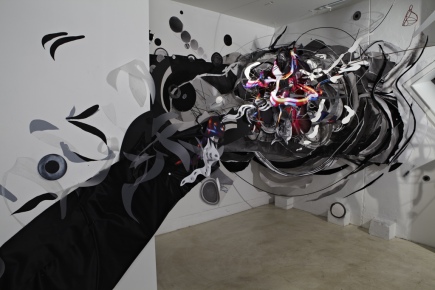 |
||
|
December 2010
Exhibition - YANN LESTRAT - Current works (FRANCE) Emerging French artist Yann Lestrat presents his latest works. Creating invariably simple forms that claim an absolute yet unattainable perfection : polished steel, laminated monochrome acrylic paintings and transparent plexiglass plates, Yann's use of techniques and skills from the industrial world contrbutes to his interest in the "finish" of the work but also, paradoxically, his detachment from reality. His creative research often explores landscape, public spaces and familiar domestic objects, to which he introduces unexpected aspects that disturb their common use/ perception and the established order. 9 photographs The result of several years of photographic exploration that focuses on images of domestic lighting (lamps, ceiling lights, chandeliers), taken randomly on visits and trips. These images are selected and reworked in order to bring out in each a strangeness/ambiguity that such common objects can sometimes conceal and to which we often pay little or no attention. Captured in this way the objects take on the appearance of bioluminescent creatures of the deep, or even of spacecraft straight out of a science fiction movie. Whether from an underwater or inter-galactic world, the photographs carry with them a certain humour, given the modesty of their origin, as well as poetry and imagination. Nevroz A sculpture that wickedly condenses and heightens the rudiments of a spirit level : Called Nevroz, the object is made of bakelite and displays a bubble inside a circular window. Spherical, this precision tool is in perpetual imbalance, it is an impossible and surreal measuring instrument, caught between ordinary object and sculpture. From the viewpoint of design, the ‘Nevroz’ spirit level is a mobile sculpture set in precarious balance that will not enable one to find the strict line you’re looking for… Work co-produced by La Criée , Contemporary Art Center, Rennes, with the support of SEPA / Bon Accueil, Rennes. "Nevroz" Reissued 2010 in partnership with Tamawa (Brussels). "Et in arcadia ego / Iceland" This is a body of work explored by the artist since 2003 with the idea to set up and photograph a stainless steel evacuation plug of 100 cm in diameter within the natural landscape . The trip to Iceland, which took place in September 2007, is the first realization of this project abroad. The book, without text or commentary, presents three series of photographs showing the installation of the plug in the Icelandic countryside, together with the ins and outs of the trip and a set of Polaroids taken after the extraction of the plug. Additionally a DVD insert has two documentary films by Nicolas Touzalin. "Et in Arcadia Ego, Iceland", (2009) Zedele Editions (Brest) Public Collections
|
  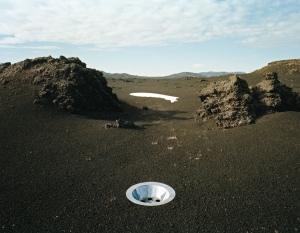 More images >> |
||
|
October/November 2010
ARTIST IN RESIDENCE - BRITT SALT (AUSTRALIA) My current practice exercises a multitude of ephemeral lines and the transparency of mesh to create works that reposition the way we know and experience space.
|
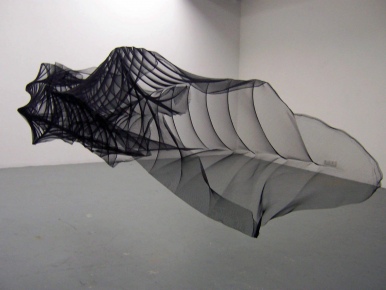 |
||